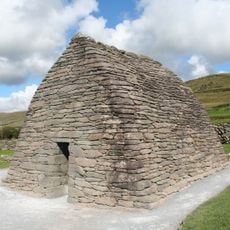
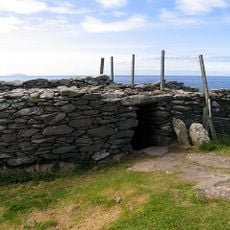
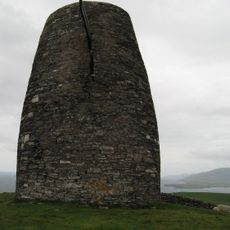
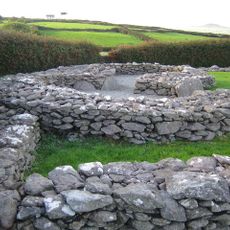
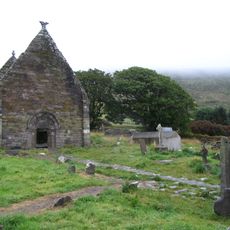
Temple-Managhan, oratory in Ballymorereagh, County Kerry, Ireland
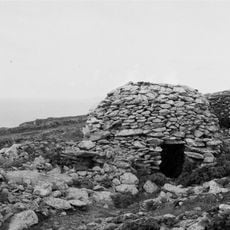
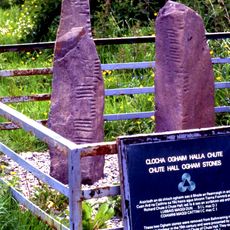
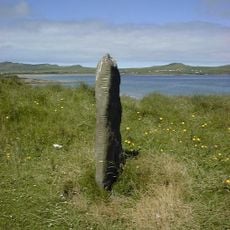
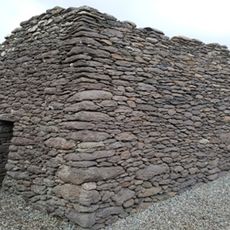
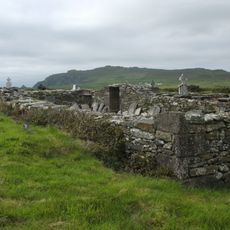
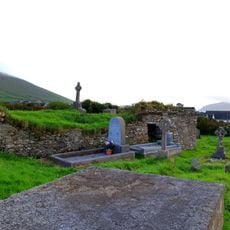
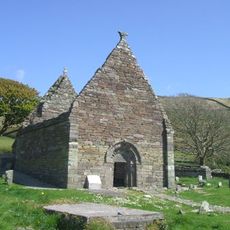
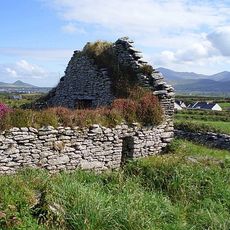
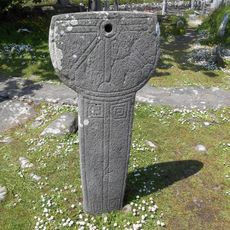
Temple-Managhan is a boat-shaped dry-stone oratory at Ballymorereagh, 4.5 km west-northwest of Dingle. It stands 2.75 m high with a finial, and its ogham stone (CIIC 170), 1.68 m tall, bears the inscription QENILOCI MAQI MAQI-AINIA MUCOI.
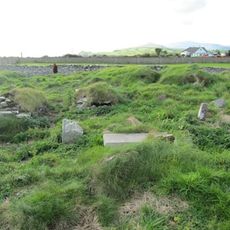
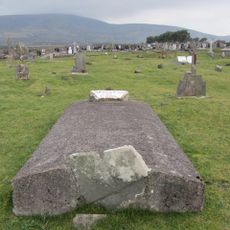
The site was in use between the 5th and 7th centuries AD, and the oratory is attributed to St. Manchan. The ogham stone, CIIC 170, bears the inscription QENILOCI MAQI MAQI-AINIA MUCOI, and Sabine Ziegler dated it to 400–700 AD. The souterrain Poll na Sagart and cross-inscribed slabs lie nearby.
The name An Teampall Geal means "the bright church". The ogham stone, CIIC 170, carries the name Cellach in the formula "of Cellach, son of the son of Ania", and its west and east faces bear carved Greek crosses. The souterrain is called Poll na Sagart, the priest's hole, from legends that priests hid there in the Penal era.
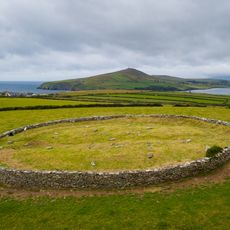
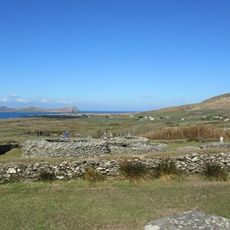
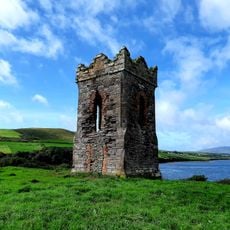
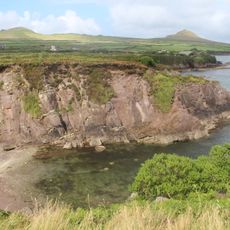
The site is located roughly 4.5 kilometers west-northwest of Dingle and sits on an elevated position with broad views across the surrounding landscape. Access involves a short walk from a farm parking area through fields and gates to reach the oratory.
The souterrain Poll na Sagart is built of dry-stone masonry in at least three chambers, and it cannot be entered today. Its name, "the priest's hole", comes from the widespread legend that Catholic priests hid in such passages during the Penal era. Excavations elsewhere have led archaeologists to rule out defence, stabling and storage, and to favour a ritual function for souterrains.
The community of curious travelers
AroundUs brings together thousands of curated places, local tips, and hidden gems, enriched daily by 94,405 contributors worldwide.