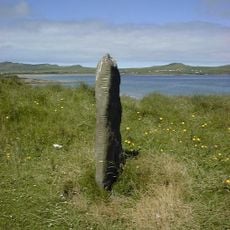
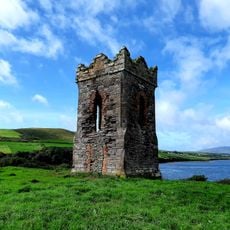
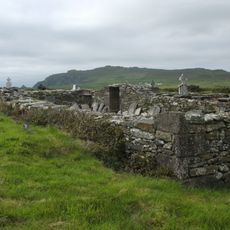
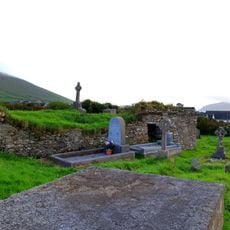
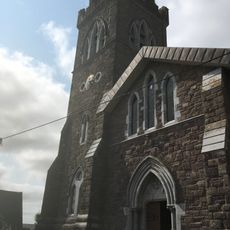
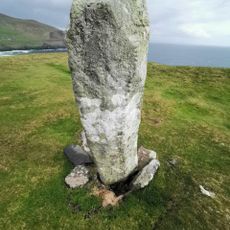
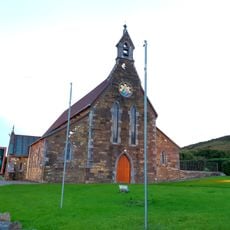
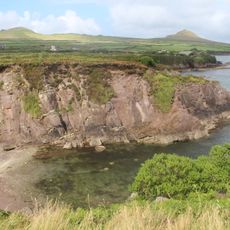
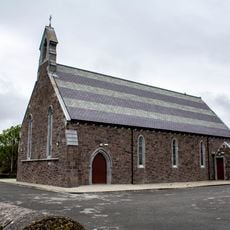
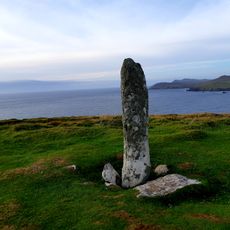
Dunbeg Fort, Iron Age promontory fort on the Dingle Peninsula, Ireland.
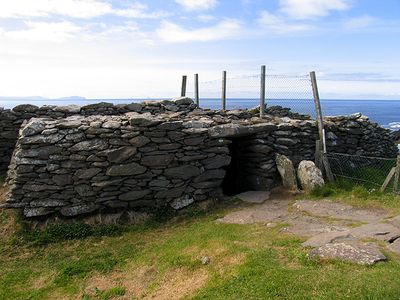
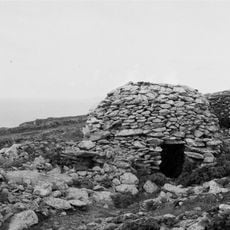
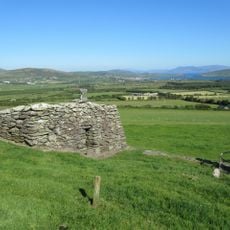
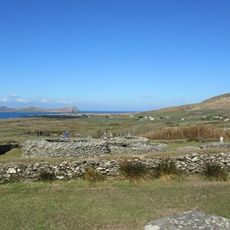
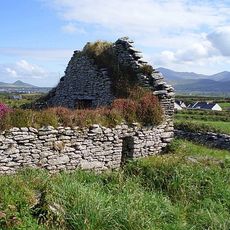
Dunbeg Fort is an Iron Age promontory fort on a rocky point south of Slea Head, County Kerry. A dry stone wall, once 61 m long and up to 7.6 m wide, cuts off a triangular headland above Dingle Bay. In front of it lie four parallel ditches separated by three clay and gravel mounds, and inside stands a single large beehive hut.
Dunbeg Fort's construction date is uncertain, but a wood sample from a ditch under the stone wall was dated to around 580 BC, so the wall is no older than that. Another wood sample from a deposit over a retaining wall gave around 800 AD, showing the wall predates that. The drystone clochán inside was built in the 10th century AD.
The Irish name An Dún Beag means "the small fort". The site is grouped with the beehive huts of nearby Fahan, and a 16.5 m souterrain roofed with large slabs runs from the interior towards the outer wall. Inside stand the remains of a house that is rectangular within and round outside, a form also found at Clochán na Carraige on Inishmore.
Dunbeg Fort stands directly on the R559, the Slea Head Road, just south of Slea Head. The site has been closed to visitors since January 2018, when a storm and a subsequent slope collapse destroyed large parts of the fort and the entrance doorway was declared unsafe by the Office of Public Works. The fort and its clocháns can still be viewed from the road.
A 16.5 m souterrain roofed with large stone slabs runs from inside the fort out close to the outer wall. Inside stand the remains of a house that is rectangular within and round outside, a form also found at Clochán na Carraige on Inishmore. The entrance lintel, 7 feet long, was called the most remarkable in Ireland by Macalister in 1898.
The community of curious travelers
AroundUs brings together thousands of curated places, local tips, and hidden gems, enriched daily by 94,232 contributors worldwide.