Green Street Court House, Neoclassical courthouse in Smithfield, Dublin, Ireland
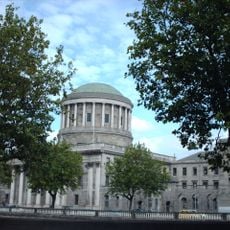
Green Street Courthouse is a neoclassical courthouse between Green Street and Halston Street in Smithfield, Dublin. Built in ashlar stone and completed in 1797, it has a symmetrical frontage facing Smithfield, with a central hexastyle portico of Doric columns supporting an entablature and a modillioned pediment. The architect is believed to have been Whitmore Davis.
The building opened in the late 1700s and operated as a primary criminal court for over two centuries before its role changed in the early 2000s. Key trials of Irish political figures took place here during the 1800s, establishing its importance in Dublin's legal history.
The courthouse stands on part of the "Little Green", land once owned by St. Mary's Abbey and later used as a graveyard. Before 1797 the city's sessions house was the Tholsel, beside the Church of St. Nicholas Within. The building also served to elect Dublin City's members of the UK parliament.
The courthouse sits between Green Street and Halston Street in a busy part of Dublin with straightforward street access. Visitors should check ahead about which areas remain open to the public, as parts of the building serve specific judicial functions and may have restricted access.
On 16 July 1976, three IRA bombs exploded at the courthouse, breaching a side door and allowing five defendants on trial for bombmaking to escape; four were caught nearby. The building was also modified for the February 1976 trial of the kidnappers of Tiede Herrema.
The community of curious travelers
AroundUs brings together thousands of curated places, local tips, and hidden gems, enriched daily by 94,466 contributors worldwide.