Donegal Friary, Franciscan friary in County Donegal, Ireland
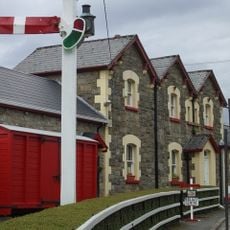
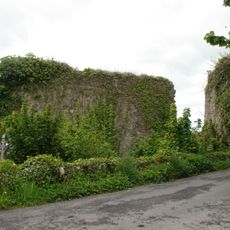
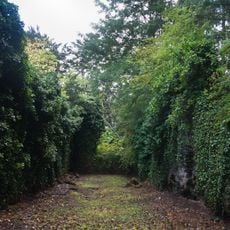
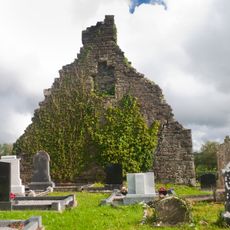
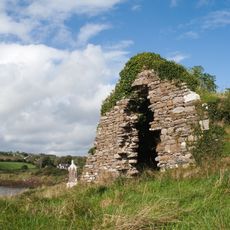
Donegal Friary stands by the wharf at the mouth of the River Eske, west of Donegal town centre. The cloister garden lay north of the nave, with twelve narrow arcades per side; octagonal shafts survive on the east side, simpler chamfered piers on the north. Only part of the nave's north wall and some choir masonry remain.
Donegal Friary was founded in 1474 by Hugh Roe O'Donnell, ruler of Tyrconnell, and his wife Finola O'Donnell, who had travelled to Ross Errilly to request the Franciscans. Finola died before building finished, and Hugh's second wife Fingalla O'Brien completed the church and cloisters. A fire damaged much of it in 1536; in 1601 an explosion of gunpowder stored by Niall Garve O'Donnell destroyed most of the buildings, and it was never rebuilt.
The friary's name lives on in the work of its former monks: between 1632 and 1636, Mícheál Ó Cléirigh, Cú Choigcríche Ó Duibhgeannáin and Fearfeasa Ó Maol Chonaire compiled the Annals of the Four Masters at Bundrowes, near Bundoran. The community later moved to Rossnowlagh, where the convent was re-established in 1946.
The ruins are open for visitors to explore on foot along maintained pathways around the site. Wear sturdy shoes as the ground is uneven and some stone structures remain fragile.
The friary's most important legacy was produced elsewhere: after 1601 the friars settled at Bundrowes near Bundoran, and between 1632 and 1636 Mícheál Ó Cléirigh, Cú Choigcríche Ó Duibhgeannáin and Fearfeasa Ó Maol Chonaire worked there on the Annals of the Four Masters.
The community of curious travelers
AroundUs brings together thousands of curated places, local tips, and hidden gems, enriched daily by 94,105 contributors worldwide.