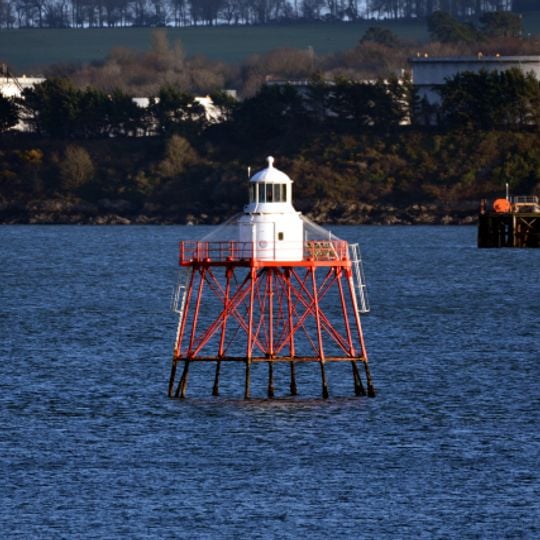
Spit Bank Lighthouse, Maritime navigation aid in Cork Harbour, Ireland.
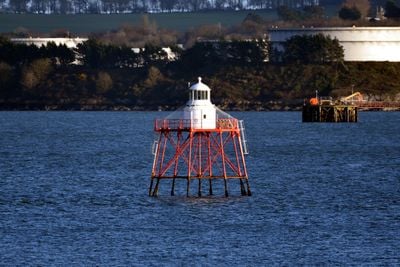
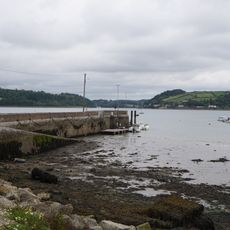
Spit Bank Lighthouse is an octagonal sheet-iron tower and lantern on a platform carried by nine cast-iron screwpiles, each 60 cm in diameter and driven about 5.2 m into the seabed. The tower and lantern are painted white, while the platform and piles are red. It stands on a shallow bank between Spike Island and Cove Fort in lower Cork Harbour.
Alexander Mitchell, blind since 1802, moved to Cobh in 1851 to supervise the foundation works, reportedly examining joints by touch from small boats. His nine cast-iron screwpiles, 60 cm across and driven about 5.2 m into the seabed, support a platform with an octagonal sheet-iron light designed by George Halpin. First lit in 1853, it replaced an unlit buoy marking a turn in the main channel; it was repaired after a 1978 collision and renovated in 2013.
The light marks the boundary of compulsory pilotage for large vessels entering the Port of Cork, so ships take a pilot aboard near this point. Its keepers came out from Cobh, less than half a mile away, since the structure has no permanent accommodation. The tower and lantern are painted white, the platform and piles red.
The lighthouse emits a white light at night that is visible from considerable distance, with a red warning light providing additional safety guidance to vessels. Access to the structure itself is restricted since it stands in open water, so viewing is best done from nearby boat tours or harbor viewpoints.
The lighthouse rests on nine independent screw piles that were twisted individually into the seabed rather than relying on conventional foundations. This design allows the structure to sway slightly during storms rather than resist force rigidly.
The community of curious travelers
AroundUs brings together thousands of curated places, local tips, and hidden gems, enriched daily by 94,227 contributors worldwide.