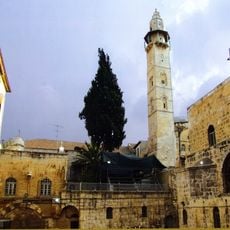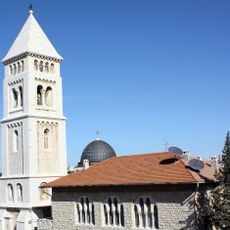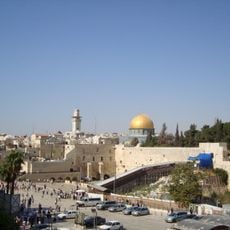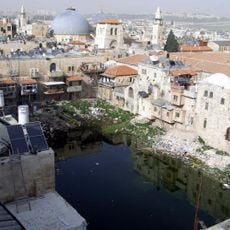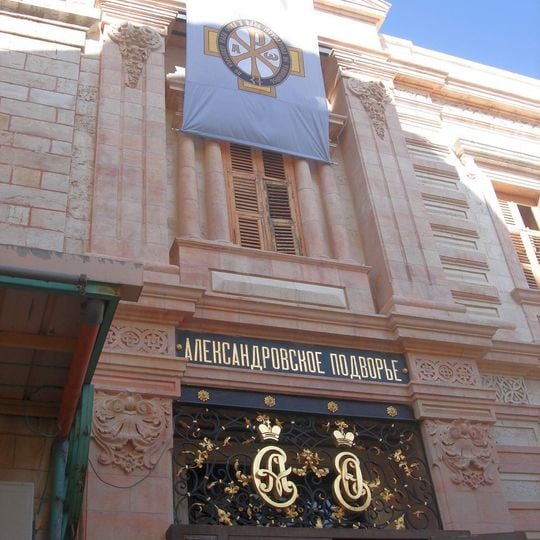
Alexander's Courtyard, Russian Orthodox church and monastery in Old City, Jerusalem, Israel
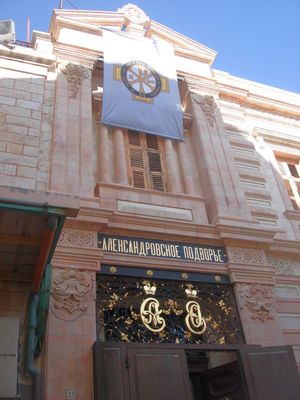
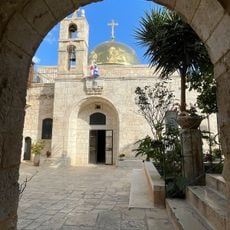
Alexander's Courtyard is a walled archaeological and architectural compound in the Christian Quarter of Jerusalem's Old City, about 70 m from the Church of the Holy Sepulchre. Its most spacious hall holds the Church of St Alexander Nevsky, with a two-tier carved wooden iconostasis, icons and paintings by N. A. Koshelev, and Russian Art Nouveau stained glass behind the altar. The grounds also contain excavations, a small museum and pilgrim rooms; the total area is 1,433 m².
The land was bought from the Coptic clergy in 1859 through the efforts of Vladimir Dorgobuzhinov, Russia's first consul in Jerusalem, originally for a consulate. After Grand Duke Sergei Alexandrovich's pilgrimage in 1881, excavations led by Archimandrite Antonin began, with Conrad Schick, Charles Wilson, Melchior de Vogüé and Charles Clermont-Ganneau taking part. In 1883 the Threshold of the Judgment Gate and a fragment of Jerusalem's Second Wall were found. Building above the dig was completed in 1891, and the Church of St Alexander Nevsky was consecrated on 22 May 1896.
The compound serves Russian Orthodox believers who gather for religious ceremonies and find lodging during their visits to Jerusalem. Visitors notice traditional religious artworks and icon displays that reflect the spiritual life of the community.
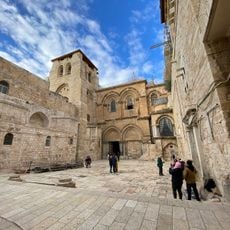
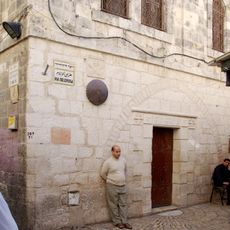
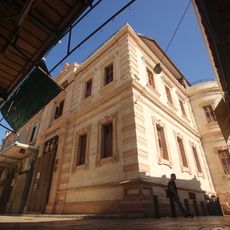
The complex stands in the Christian Quarter, southeast of the Church of the Holy Sepulchre, on the northeast side of the street running parallel to it, facing the Church of the Redeemer. The entrance is on that street; the total area of the courtyard is 1,433 square metres. Beside the Threshold of the Judgment Gate, a small hole in the surviving wall fragment, called the Eye of the Needle, let travellers enter the city after the gates closed for the night.
The Threshold of the Judgment Gate, a stone slab in the courtyard, is traditionally identified as the gate through which Jesus passed on the way to Golgotha. Beside it, a small hole in the wall, called the Eye of the Needle, allowed entry after the city gates closed for the night.
The community of curious travelers
AroundUs brings together thousands of curated places, local tips, and hidden gems, enriched daily by 92,657 contributors worldwide.