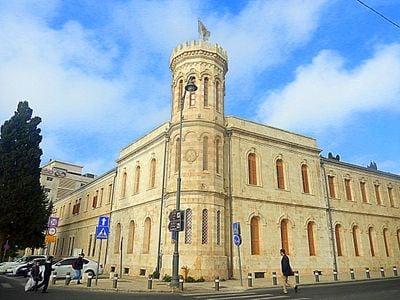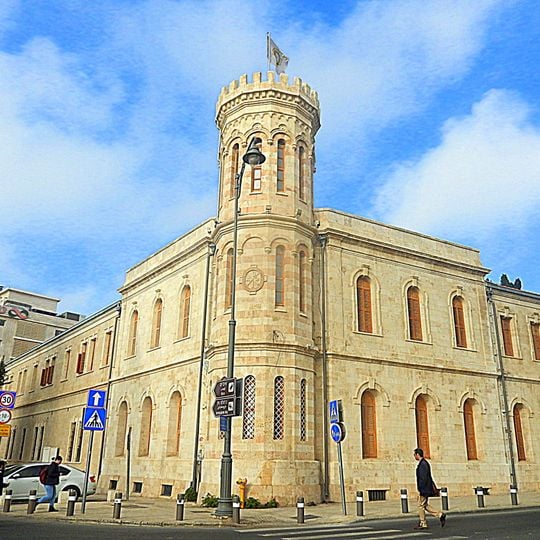
Mission of Saint Sergius of Jerusalem, Russian Orthodox mission building in Jerusalem, Israel
The Mission of Saint Sergius, or Sergiyevskoye Podvorye, is a two-storey stone building at 13 Heleni HaMalka Street, on the corner of Monbaz Street near Jaffa Road in Jerusalem. It was designed by the Jerusalem architect Georgy Frangia and built between 1886 and 1890 for the Imperial Orthodox Palestine Society. A round corner tower with a crenellated parapet and a flagpole rises above the roof; the lower floor has tall arched windows with dark grilles, the upper floor arched windows with brown shutters.
The Imperial Orthodox Palestine Society bought the 4,252 m² plot near the Russian Compound in May 1886 and built the guest house between 1886 and 1890 to the design of Jerusalem architect Georgy Frangia, under Dmitry Smyshlyaev. It was consecrated on 20 October 1889 by Archimandrite Antonin (Kapustin); the second-floor sections beside the central tower were finished by 1891. First called the New Compound, it was renamed for Grand Duke Sergei Alexandrovich after his assassination in February 1905.
The building was first called the New Compound and was renamed for Grand Duke Sergei Alexandrovich after his assassination in 1905. Its ground floor held an icon shop, a souvenir shop, a food shop and a public dining hall for all Russian buildings in Jerusalem. The society also held "Palestinian readings" with lantern slides in the dining hall or courtyard, and at Easter organized meals for Russian Orthodox pilgrims.
The building stands at 13 Helene HaMalka Street, on the corner of Monbaz Street, a short walk from Jaffa Road. Its ownership was long disputed: the state paid 4.5 million dollars under the 1964 agreement with Moscow, yet the Sergei building's title was never settled and the Administrator General managed it until the 2008 court decision transferring it to state property.
The building was first called the New Compound; it was renamed for Grand Duke Sergei Alexandrovich only after his assassination in February 1905. Its architect was Georgy Frangia, a Jerusalem-based member of the Imperial Orthodox Palestine Society, and the land of 4,252 m² was bought in May 1886 from the Ottoman subject Musa Tannus.
The community of curious travelers
AroundUs brings together thousands of curated places, local tips, and hidden gems, enriched daily by 92,632 contributors worldwide.