Great Mosque of Ramla, Mosque and minor basilica in Ramla, Israel
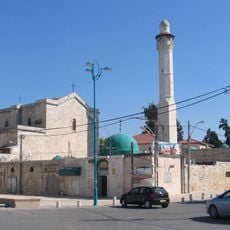
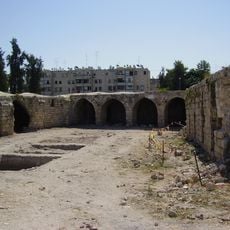
The Great Mosque of Ramla is a religious building with three parallel halls and a central nave, displaying the layout of a classical basilica. The interior is structured by columns that divide the different sections from one another.
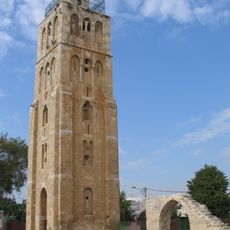
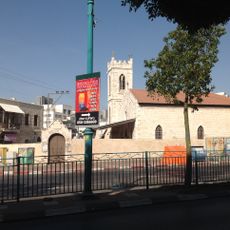
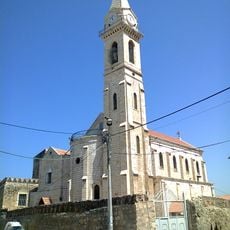
The building was erected in the mid-12th century as a Crusader cathedral dedicated to John the Baptist, built on the mistaken identification of Ramla with Ramah, the town of Joseph of Arimathea. It served the Crusaders until 1260, when the Mamluks under Baybars took the region and expelled the Christians, turning the cathedral into a mosque. Mamluk work added a minbar and mihrab, and two dedication inscriptions above the northern doorways name Baybars (1268) and Sultan Qutbugha (1298); the minaret was restored in 1314.
The mosque keeps the Crusader church's footprint: a 12th-century basilica dedicated to John the Baptist, about 60 m long and 20 m wide, with eight columns per side whose capitals carry plant motifs. In the west corner of the courtyard stands the Crusader entrance gate of three arches on three columns, read as an allusion to the Trinity. The Mamluk mihrab and minbar face Mecca.
Visitors can enter on most days and should wear comfortable shoes as the floors may be uneven in places. It is wise to check the exact opening times ahead of time and dress modestly.
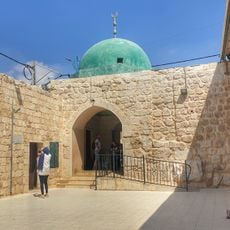
In the courtyard stands a domed tomb that Muslim tradition identifies as the burial place of Shahab al-Din, a senior officer in Saladin's army killed at the Battle of Hattin in 1187. The same figure is also linked to the Maqam Shahab al-Din in Nazareth, known as the Mosque of the Quarrel.
The community of curious travelers
AroundUs brings together thousands of curated places, local tips, and hidden gems, enriched daily by 92,753 contributors worldwide.