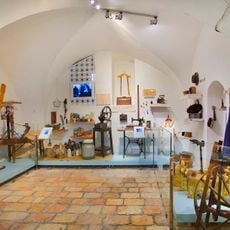
Israelite Tower, Archaeological site in Jewish Quarter, Jerusalem, Israel
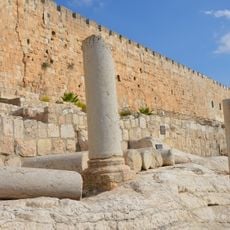
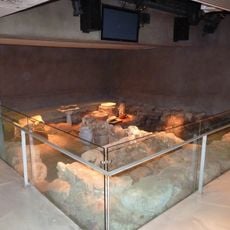
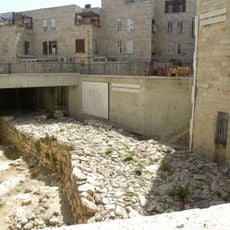
The Israelite Tower is an archaeological site in the Jewish Quarter that displays remains of ancient defensive walls. The structures consist of stacked stone layers and provide insight into how buildings were constructed about 2,500 years ago.
The Israelite Tower was built in the late Iron Age, probably in the 8th century BCE, as part of Jerusalem's northern wall, perhaps the Middle Gate of Jeremiah 39:3. It was excavated by Nahman Avigad in the 1970s. Four arrowheads found in the ash layer, one bronze of Scytho-Iranian type used by Babylonian archers, attest to the Babylonian siege and destruction of 586 BCE. A Hasmonean tower was later built against it.
The name refers to the earlier of the two towers, dated to the Israelite (First Temple) period. The Hasmonean tower beside it was built about 500 years later, and the two Jewish fortifications stand almost touching. The site reopened to visitors in 2015 after radon gas traces found in the early 2000s had led to its closure.
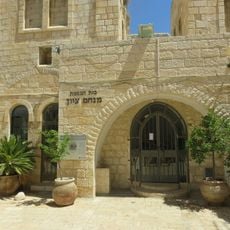
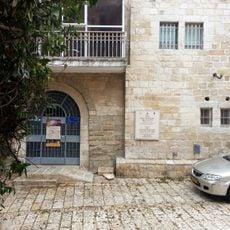
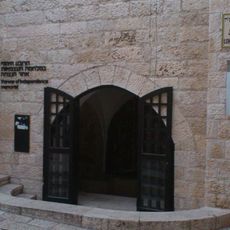
The Israelite Tower lies at the corner of Plugot HaKotel and Shonei HaLakhot streets in the Jewish Quarter, preserved beneath a school. Access is limited and requires a reservation. The site reopened to visitors in 2015 after being closed due to radon gas.
Four arrowheads were found in the soot at the tower's base on the last day of the 1975 season: three iron, one bronze with three triangular fins and a hollow socket, a Scytho-Iranian type used by Babylonian archers after 600 BCE. They are thought to be the first remains of the Babylonian siege of 586 BCE ever recovered.
The community of curious travelers
AroundUs brings together thousands of curated places, local tips, and hidden gems, enriched daily by 92,775 contributors worldwide.