The Assyrian Fortress, Tell in Israel
The Assyrian Fortress is a square structure of sun-dried mudbricks, 15.5 by 15 metres, on a sand hill about 50 metres above sea level in south-western Rishon LeZion. Its walls stand 3.5 metres high on foundations up to 3.8 metres wide, with a central sunken chamber entered through its ceiling and 11 rectangular cells around it. A 45-degree glacis runs down the steep northern side.
The structure dates to the 8th century BCE; its original name is unknown. Its construction may be attributed to Sargon II (722–705 BCE) on his way south toward Ashdod, though the scant finds also fit a local fortress near a Philistine city, or continued use in the Persian period. No evidence of destruction was found, and the site appears to have been abandoned at some stage.
The site's name is modern: the original Assyrian name is unknown. Finds of jars, small jugs, pots and bowls from the 7th century BCE, plus burnt patches with animal bones and pottery, point to short stays and night camps on the mound rather than a settled town.
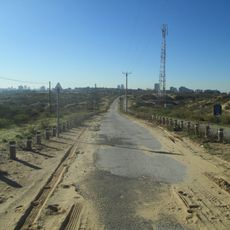
The tell rises about 30 metres above its surroundings, and the top is reached only by unmarked sand paths; access is not organised. The main find is sheltered by a low tin roof that makes approach difficult, and as of 2022 the site was dirty and neglected. Yitzhak Rabin Boulevard was shifted south to spare the remains, and a retaining wall along the road, with paintings and reliefs by artist David Katz, imitates an Assyrian fortress wall. The city plans an archaeological park around the site.
The mud-brick walls stand 3.5 m high on foundations 3.8 m wide, and the 11 surrounding cells have no outer openings, no floors and no doors between them. Excavators therefore think they served only as a raised platform for a structure above, a technique known in Assyrian and Babylonian architecture.
The community of curious travelers
AroundUs brings together thousands of curated places, local tips, and hidden gems, enriched daily by 94,035 contributors worldwide.