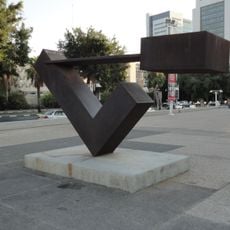
Sacrifice of Isaac, Steel sculpture in Tel Aviv, Israel.
Sacrifice of Isaac is a laser-cut Corten steel sculpture made by Menashe Kadishman between 1982 and 1985, set on the plaza of the Tel Aviv Museum of Art near the courthouse. It has three parts: a large ram standing above the hollow face of the dead Isaac, and two mourning women embracing at the side.
Kadishman returned to Israel in 1972 after 13 years in London. After the Yom Kippur War, George Segal used Kadishman and his son Ben as models for his own Sacrifice of Isaac, with Kadishman as Abraham. In 1982 his mother died, he underwent intestinal surgery and his son was drafted for the Lebanon War; the sculpture, third in the series, was made in 1982–1985.
Kadishman removes Abraham from the biblical story and puts the ram in his place, as the figure who sends the sons to death and also mourns them. The dead Isaac's hollow face and the two embracing mourners draw on Christian Pietà imagery, giving the grief of women a central place the Hebrew Bible and Israeli heroism narratives leave out.
The sculpture stands outdoors on the plaza of the Tel Aviv Museum of Art, next to the courthouse, so it can be seen at any time without a ticket. It is a short walk from the museum's main entrance and reachable by bus or train.
Kadishman removes Abraham from the biblical story and gives his role to the ram, which stands above the dead Isaac; the hollow face of Isaac reappears in his later works, such as "Shalechet" at the Jewish Museum in Berlin and "Skulls" at Yad Vashem. The two mourning women borrow from the Christian Pietà.
The community of curious travelers
AroundUs brings together thousands of curated places, local tips, and hidden gems, enriched daily by 93,878 contributors worldwide.