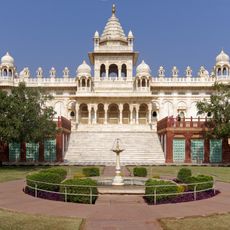
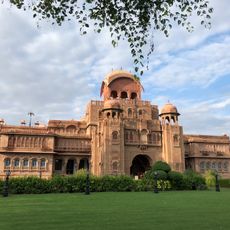
Lalgarh Palace, Royal palace building in Bikaner, India.
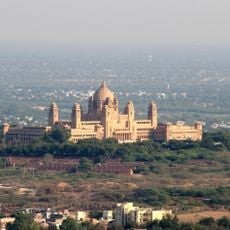
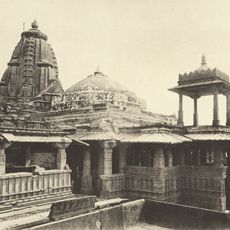
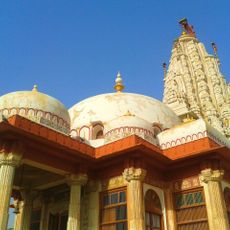
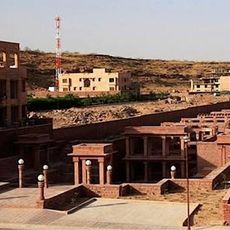
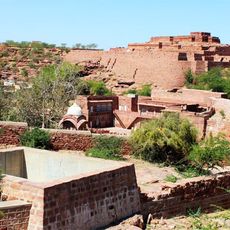
Lalgarh Palace is a royal residence in Bikaner built from red sandstone, featuring multiple courtyards, gardens, and intricate latticework throughout its structure. The building combines Indian and European architectural styles in an elaborate design from the early 1900s.
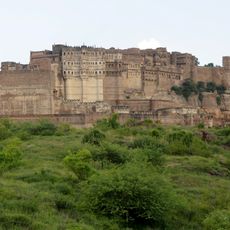
The palace was commissioned by the British-controlled regency for Maharaja Ganga Singh while he was still a minor, as they deemed Junagarh Fort unsuitable for a modern monarch. Construction began in 1896 on empty land five miles from the fort, and the complex was completed in 1926. Ganga Singh named it in memory of his father, Maharaj Lal Singh.
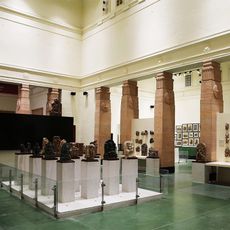
The palace is named after Maharaja Lal Singh, Ganga Singh's father, and its Laxmi Niwas wing was praised by Stanley Reed in 1905-06 as the most perfect modern Indo-Saracenic building in India. The Shri Sadul Museum in the west wing holds the fourth largest private library in the world, with manuscripts and wall paintings. The Karni Niwas wing contains a darbar hall and an art deco indoor swimming pool.
The complex is split between uses: the Shri Sadul Museum in the west wing opens 10:00 AM to 5:00 PM on all days except Sunday, while Laxmi Niwas Palace is leased as a separate hotel. The palace stands on Dr. Karni Singhji Road, about 5 miles from Junagarh Fort, and the Bikaner royal family still keeps a private residence in one wing.
The palace's Karni Niwas wing holds an art deco indoor swimming pool, and the complex's dining room was built to seat 400 diners. The Shri Sadul Museum in the west wing keeps the fourth largest private library in the world. The palace appears as Fawad Khan's royal residence in the film Khoobsurat.
The community of curious travelers
AroundUs brings together thousands of curated places, local tips, and hidden gems, enriched daily by 92,804 contributors worldwide.