Jogeshwari Caves, Hindu cave temple in Mumbai, India
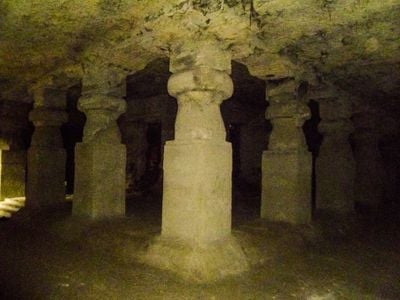
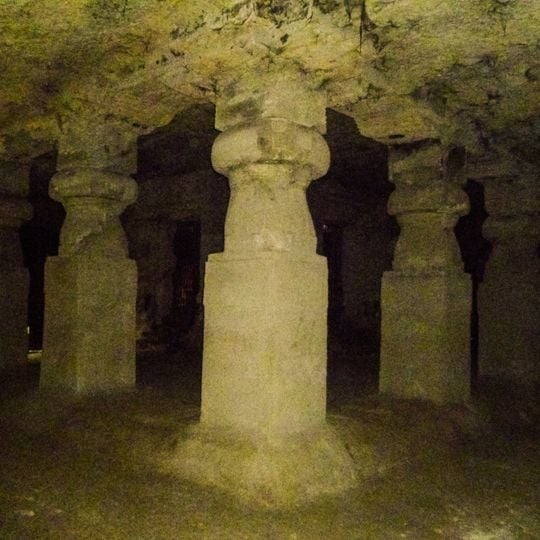
The Jogeshwari Caves are a cave temple in Jogeshwari, Mumbai. A long flight of stairs leads into a main hall with many pillars and a lingam at the end. The photograph shows a pale, yellowish-beige stone pillar with a plain base, a shaft that narrows slightly, and a capital carved into rounded, cushion-like bands, supporting a carved ceiling.
The caves were carved between 520 and 550 CE, in the late phase of Mahayana Buddhist architecture, and are among the earliest Hindu cave temples in India. Historian Walter Spink called Jogeshwari the earliest major cave temple in the country and, by total length, the largest. They are the earliest Pashupata caves in Mumbai.
The goddess Jogeshwari (Yogeshwari) gives the caves and the suburb their name; her murti and footprints are kept here. Some Marathi people regard her as their Kuladevi, and migrant groups from Gujarat also worship her. Six sculptural panels depict Shaiva episodes, among them the marriage of Shiva and Parvati, Andhakasura Vad, Shiva accepting Ravana as a disciple, Shiva and Parvati playing dice, Nataraja and Lakulisha Shiva.
The site is easiest to reach by local train to Jogeshwari station, followed by a short auto-rickshaw ride to the entrance. Wear comfortable shoes since the stairs and pathways are uneven, and bring a light or flashlight because the caves are dimly lit.
Walter Spink called Jogeshwari the earliest major cave temple in India and, by total length, the largest. The cave also preserves sculptures and pillars in Mahayana Buddhist style, and the site is counted among Mumbai's earliest Pashupata caves.
The community of curious travelers
AroundUs brings together thousands of curated places, local tips, and hidden gems, enriched daily by 92,678 contributors worldwide.