Hesaraghatta Lake, Artificial reservoir in Bengaluru, India.
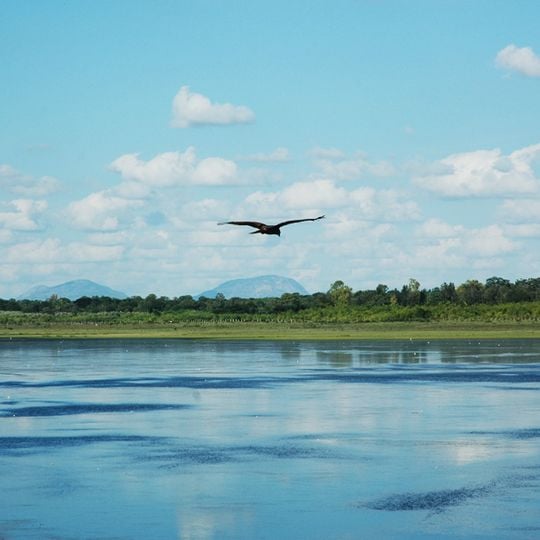
Hesaraghatta Lake is a reservoir on the Arkavathy River, held back by an earthen bund 1,690 m long and 40.55 m high, with a surface of 450 hectares at full level. In the photograph a flat sheet of water lies below a line of low trees and green vegetation on the far shore, with hills and a dark bird with long angled wings against a cloudy blue sky.
The reservoir was created in 1894 under the Chamarajendra Water Works scheme, planned by Dewan K. Seshadri Iyer with chief engineer M. C. Hutchins, to store a three-year supply for Bengaluru. Water reached the city from 1896, serving about 250,000 people at 55 litres a day for 37 years. After the 1924-27 drought, the Chamaraja Sagar reservoir at Thippagondanahalli was built downstream as a replacement source.
The lake's Kannada name is Hesaraghatta Kere, and for centuries its water irrigated farmland in Doddaballapura and Nelamangala taluks and supported betel-vine cultivation. Fishing and dairy farming fed local families for generations. The reservoir also hosted river rafting and windsurfing before it dried up.
The lake lies 26.5 km northwest of Bengaluru by road. It dried up in 2020 and refilled in 2022 after heavy rain, so water levels vary greatly. The lakebed is hot, about 1°C warmer than Bengaluru, and vehicle tracks crisscross the grassland.
The lake is the only known breeding site in South India of the Lilac silverline butterfly (Aphnaeus lilacinus). In summer, when the bed dries and grass covers it, visitors can also spot the butterfly Junonia almana on the exposed lakebed.
The community of curious travelers
AroundUs brings together thousands of curated places, local tips, and hidden gems, enriched daily by 92,678 contributors worldwide.