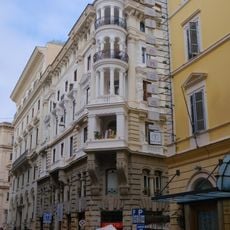
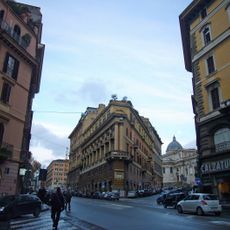
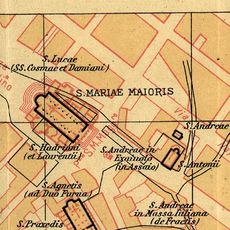
Viminal Hill, Ancient hill in Rome, Italy
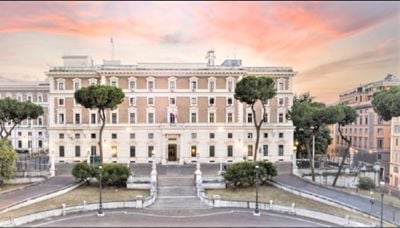
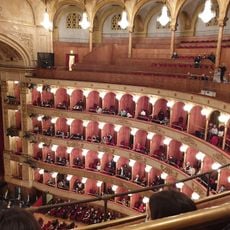
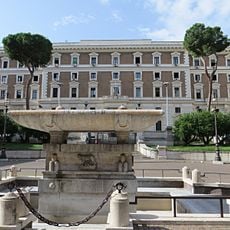
Viminal Hill is the smallest of Rome's seven hills, a finger-shaped spur rising 57 metres between the Quirinal and Esquiline. Its slopes were once covered with osiers, the willows that gave the hill its Latin name, Collis Viminalis. Today the summit holds the Palazzo del Viminale, seat of the Ministry of the Interior, while the Teatro dell'Opera and Termini Station stand on its lower slopes.
Livy records that the Viminal joined the city under Servius Tullius, Rome's sixth king, in the 6th century BC. Under Augustus it belonged to Regio VI Alta Semita, a middle-class residential district with no public buildings; rich houses of the 2nd and 1st centuries BC were excavated on Via Balbo, Via Panisperna and Via Santa Pudenziana. Between 298 and 305 AD Diocletian built his baths between the Viminal and the Quirinal.
The name comes from the Latin viminalis, referring to the osiers or willows that covered the slopes; the hill was bounded in Roman times by the Vicus Longus, today's Via Nazionale, and the Vicus Patricius, today's Via Urbana. The area now belongs to the Rione Monti.
The hill rises 57 metres near Piazza San Bernardo, between the Quirinal and Esquiline. Via Nazionale, the ancient Vicus Longus, runs along its western foot, while Via Urbana, the Vicus Patricius, borders it to the east. The Teatro dell'Opera and the Palazzo del Viminale stand on the hill itself, and Termini Station lies just beyond its northeastern edge.
The Viminal is Rome's smallest hill, rising only 57 metres near Piazza San Bernardo. Its name comes from the osiers (Salix viminalis) that once covered its slopes. Today "Il Viminale" is used as shorthand for the Ministry of the Interior, housed in the Palazzo del Viminale built in 1923.
The community of curious travelers
AroundUs brings together thousands of curated places, local tips, and hidden gems, enriched daily by 95,035 contributors worldwide.