Santa Maria della Vittoria, Baroque church near Repubblica Metro station in Rome, Italy
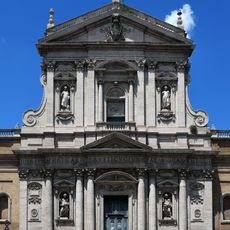
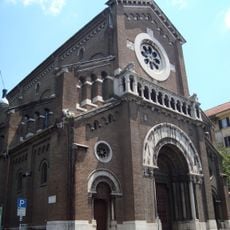
Santa Maria della Vittoria is a Carmelite church in the Baroque style near the Repubblica metro station in Rome. The interior has a single nave with three interconnected side chapels separated by Corinthian pilasters under a segmented vault, carrying gilded capitals.
The Discalced Carmelites bought the land on 20 April 1607 and built the church from 1608 to 1620 as a chapel dedicated to Saint Paul. After the Catholic victory at the Battle of White Mountain in 1620 it was rededicated to the Virgin Mary. Scipione Borghese took the Borghese Hermaphroditus found during the excavations and in return funded the facade, granting his architect Giovanni Battista Soria, whose work was carried out in 1624-1626.
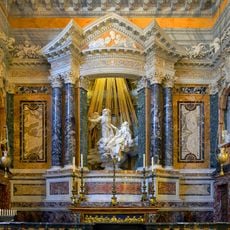
The name commemorates the Catholic victory at the Battle of White Mountain in 1620, after which the church was rededicated to the Virgin Mary; Ottoman standards taken at the 1683 Battle of Vienna were later hung inside. The Cornaro Chapel holds Bernini's Ecstasy of Saint Teresa, carved between 1644 and 1652 for Cardinal Federico Cornaro, with members of the Cornaro family shown in reliefs on the side walls as spectators in boxes.
The doors are open daily from 8:30 to 12:00 and from 16:00 to 18:00, with free entry. Repubblica metro station is just a few minutes on foot.
The light on Bernini's Ecstasy of Saint Teresa comes from a hidden window above the chapel, screened by a gilded metal sunburst; from the nave the source is invisible. On the church's outer left wall, three projecting marble brackets carry that window, a piece of engineering visitors walk past without noticing.
The community of curious travelers
AroundUs brings together thousands of curated places, local tips, and hidden gems, enriched daily by 93,354 contributors worldwide.