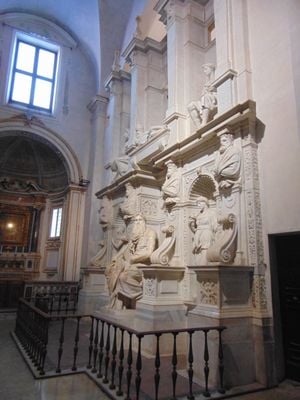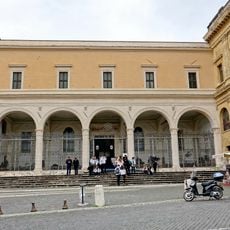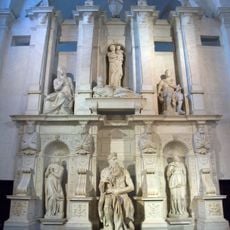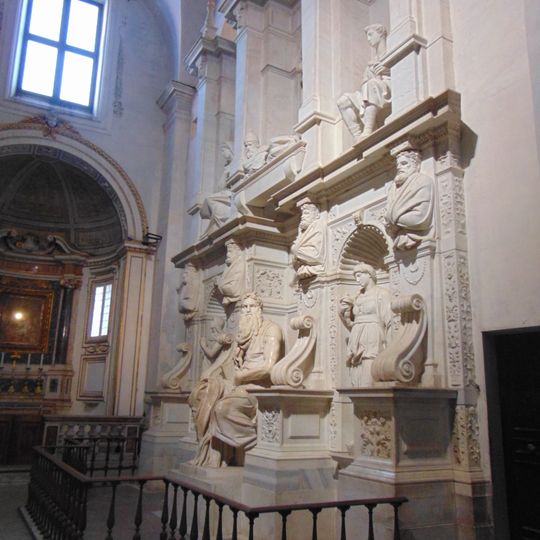
Moses, Renaissance marble sculpture in San Pietro in Vincoli church, Rome, Italy.
The figure of Moses shows the biblical character seated with the Tablets of Law under his right arm, while the muscles and drapery folds are carved in white marble. The gaze and tension of the body convey the moment as if the figure had just turned his head to observe something to the side.
Michelangelo created this work between 1513 and 1515 for the tomb of Pope Julius II, which was originally planned to be much larger. The final version of the monument was only completed in 1545 after several designs had been abandoned.
The horns on Moses' head come from the Vulgate, where Jerome rendered the Hebrew keren, usually meaning "horn" but understood as "radiating", as cornuto. Vasari reports that Rome's Jewish community came every Saturday to visit and venerate the statue. It sits in the centre of the bottom tier of Julius II's tomb.
The statue sits in the center of the bottom tier of Julius II's tomb, against the wall of the right transept of San Pietro in Vincoli, not in the open floor. Approach it frontally from the nave side; the flanking carved panels and the niche figures above are best seen by stepping back.
Vasari records that Rome's Jewish community adopted the statue as their own, visiting it in groups every Saturday to honour it as a divine rather than human work. The practice shows how a papal tomb figure became a focus of devotion for another faith.
The community of curious travelers
AroundUs brings together thousands of curated places, local tips, and hidden gems, enriched daily by 92,624 contributors worldwide.