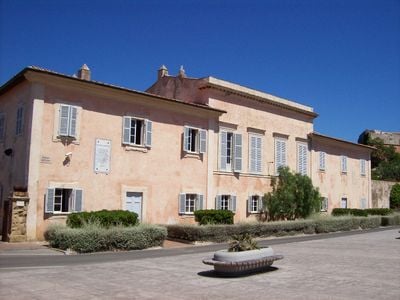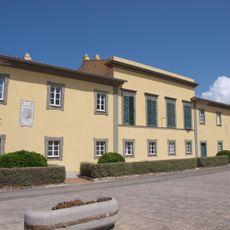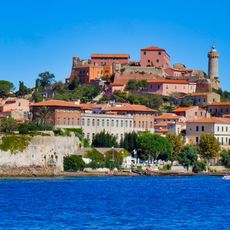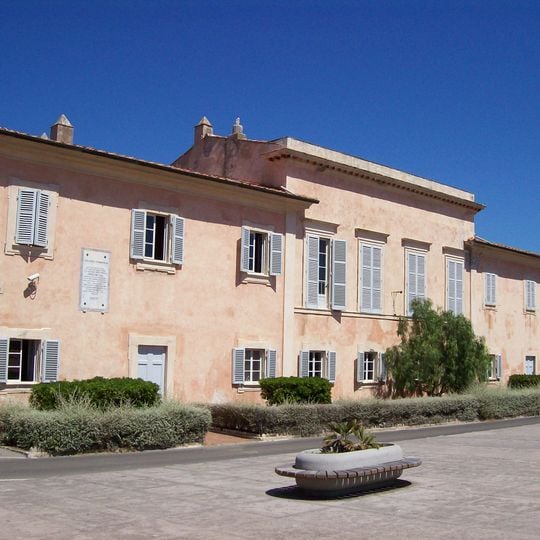
Museo napoleonico Palazzina dei Mulini, Napoleon Museum in Portoferraio, Italy.
The Palazzina dei Mulini, also known as the Museo napoleonico, is a long two-storey building with a pale salmon-pink stucco facade and a shallow pitched roof of terracotta tiles. Its roofline carries three small capped stacks on the left and a raised cornice on the right. Windows with light grey louvered shutters punctuate the facade, and two white plaques are mounted on the left side.
The villa was built in 1724 by Grand Duke Gian Gastone de' Medici. When Napoleon arrived on Elba in May 1814, he had it converted into his main residence, leaving it in February 1815 to return to France.
The building takes its name from the windmills that stood on the headland before Napoleon had them demolished for his rebuilding. The furniture he first installed came from his sister Elisa Baciocchi's residence in Piombino; that original set is now dispersed and has been replaced with Empire-style pieces. Part of the library he brought with him and gave to the town of Portoferraio is displayed here.
The villa has limited opening hours and admits only a set number of visitors per day, so checking ahead is a good idea. Comfortable shoes help, as the floors inside are uneven in places.
The garden holds an ancient Greek marble statue of Minerva, which has no direct connection to Napoleon himself. Next to it stands a copy of Canova's Galatea, an unexpected pairing that visitors often walk past without noticing.
The community of curious travelers
AroundUs brings together thousands of curated places, local tips, and hidden gems, enriched daily by 94,387 contributors worldwide.