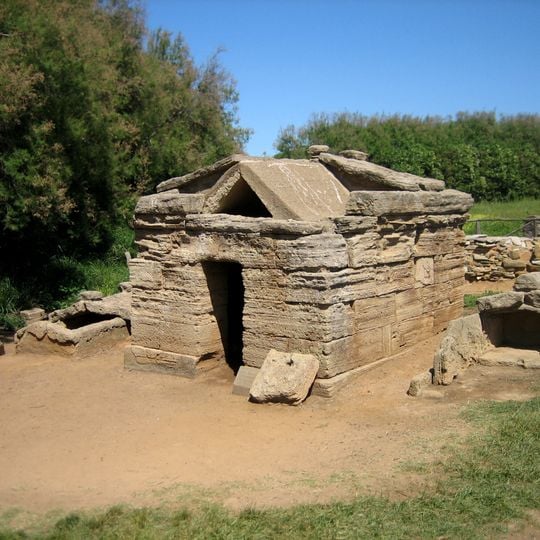
Baratti and Populonia Archeological Park, Archaeological site and national museum in Piombino, Italy.
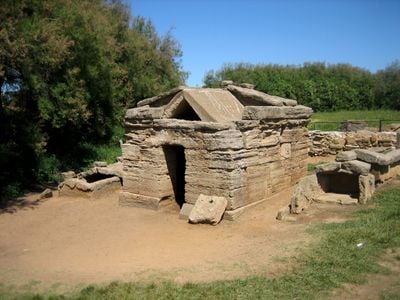
The Baratti and Populonia Archaeological Park is a large excavation site between a headland and a coastal gulf, displaying remnants of temples, tombs, and ancient roads. The ruins spread across the grounds and allow exploration of different areas of the ancient city.
The park opened in 1998 after excavations that began in 1996, making accessible the Etruscan city of Populonia and its necropolises. San Cerbone holds Orientalising tumuli and aediculae from the 7th–6th centuries BC, including the 28-metre-diameter Tomba dei Carri. The Grotte necropolis, dug in 1997–1998, has chamber tombs cut into calcarenite from the 4th–3rd centuries BC. The acropolis opened in 2007.
The park's name comes from Baratti, the gulf below, and Populonia, the Etruscan city whose tombs and workshops lie here. Along the Via del Ferro visitors pass the remains of industrial quarters where Elban hematite was turned into iron, and the ground and beach still glitter with what is left of that ore. A Centre of Experimental Archaeology lets visitors reproduce ancient objects by archaeologically documented methods.
The park covers about 80 hectares between the Piombino promontory and the Gulf of Baratti, split into separate itineraries: San Cerbone next to the visitor centre, the Via delle Cave through cork oaks and holm oaks to the Grotte necropolis, the Via del Ferro along the coast, and the Acropoli reached by Via della Romanella. Paths cross woods and uneven ground with changes of grade, so allow several hours and wear sturdy shoes.
The ground of the park and of Baratti beach sparkles in the sun because it is scattered with the remains of tonnes of hematite that Etruscans and Romans used to obtain iron.
The community of curious travelers
AroundUs brings together thousands of curated places, local tips, and hidden gems, enriched daily by 94,371 contributors worldwide.