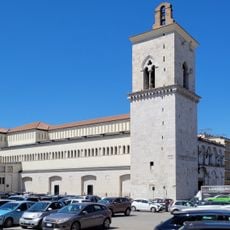
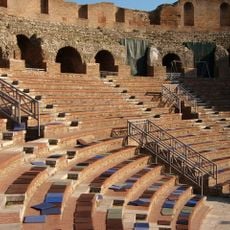
Roman Amphitheatre of Benevento, Roman amphitheatre in Benevento, Italy
The Roman Amphitheatre of Benevento was an elliptical building measuring about 160 by 130 metres, rising some 25 metres over three orders. Excavated in 1985, the visible sector shows foundation walls cast in formwork, radial walls in opus reticulatum with courses of broken tiles, and traces of plaster. An ambulatory paved in cocciopesto and the imprint of limestone pillars at the ends of the radial walls can be seen.
The amphitheatre was probably already standing in AD 63, when Nero attended a gladiatorial show in Benevento; the historian Tacitus records that the local Vatinius, a former cobbler turned courtier, staged the games in the emperor's honour. Its foundations, built over an earlier structure, date the building to between the 1st century BC and the early 1st century AD. It was abandoned after an earthquake in 346, and its walls were later quarried to rebuild the city walls after Totila's destruction in 545.
Gladiator fights were regularly held here, and Benevento likely hosted a branch of the Ludus Magnus, Rome's main gladiator school; a funerary inscription commemorates two retiarii who belonged to it. Reliefs showing gladiators, such as the hoplomachus in the Museo del Sannio, are attributed to the amphitheatre.
The archaeological site is accessible throughout the year, allowing visitors to explore the surviving structures. Expert guides on-site help explain the architectural details and ancient use of the venue.
Excavations at the site regularly uncover everyday objects like pottery and coins that document life in the ancient city. These finds give a direct impression of how the population lived in this center.
The community of curious travelers
AroundUs brings together thousands of curated places, local tips, and hidden gems, enriched daily by 94,552 contributors worldwide.