Egyptian obelisks of Benevento, Ancient Egyptian monuments in Benevento, Italy.
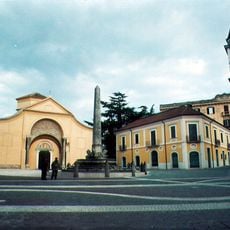
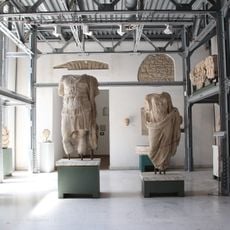
The Egyptian obelisks of Benevento are red granite monuments carved with hieroglyphics on all four sides, each rising more than three meters tall. One stands in Piazza Papiniano while the other is preserved in the Museo del Sannio.
Carved from red granite under Domitian and set up in 88–89 AD flanking the entrance of Benevento's temple of Isis, the obelisks bear hieroglyphic inscriptions that are the clearest surviving proof of that temple. Their dedicator is probably Rutilus Lupus, a wealthy Beneventan who could bring the stones from Egypt. In 1597 the better-preserved obelisk was moved before the cathedral; in 1892 Almerico Meomartini identified a fragment found in the De Simone gardens as its missing top.
The hieroglyphic text calls Isis "lady of Benevento", suggesting her cult was already strong in the city before Domitian. The inscriptions deify the emperor like a pharaoh, and scholars think the Egyptian scribes translated a Greek original, perhaps written in Alexandria.
One obelisk stands in a public square in the city center, while the other is housed in a museum that is easy to reach. Both locations are walkable from the downtown area.
The hieroglyphic text, though carved by Egyptian scribes, appears to be a translation of a Greek original, perhaps drafted in Alexandria. It calls Isis "lady of Benevento", suggesting her cult was already strong in the city before Domitian's temple. The dedicator's name was long read as Lucilius Rufus, but is now thought to be Rutilius Lupus, a family well attested at Benevento.
The community of curious travelers
AroundUs brings together thousands of curated places, local tips, and hidden gems, enriched daily by 94,094 contributors worldwide.