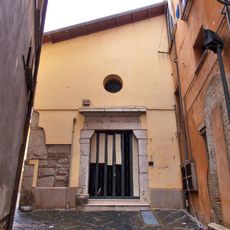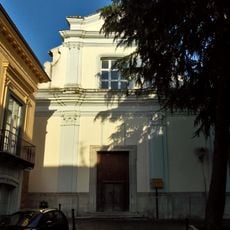
Santa Sofia monumental complex, Medieval religious complex in Benevento, Italy.
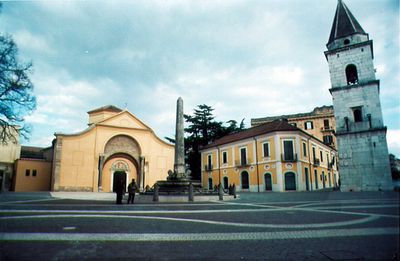
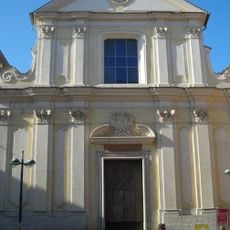
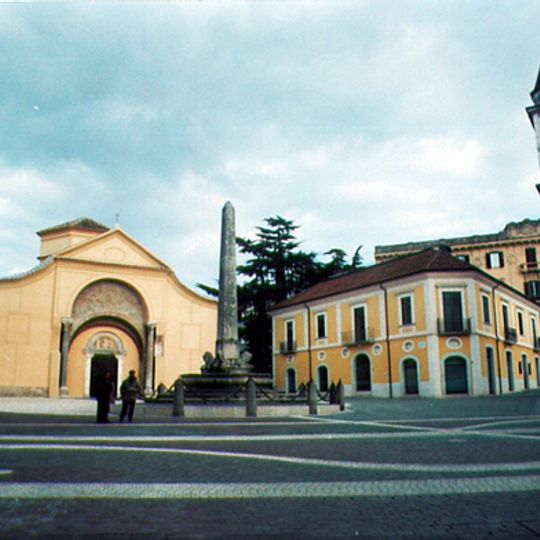
The Santa Sofia monumental complex in Benevento comprises a church, a bell tower, a former monastery with a cloister and a fountain, facing Corso Garibaldi. The church has a central plan: six columns at the vertices of a hexagon carry arches and the dome, surrounded by a decagonal ring of eight pillars and two columns flanking the entrance. The pale yellow stucco facade has a tall pediment and curved slopes from the 18th-century restoration; a grey stone obelisk stands in front.
The complex was built around 760 under Duke Arechis II, who wanted to turn Benevento into a center of Lombard power in southern Italy. That building effort marked a turning point in the city's rise during the medieval period.
The name Santa Sofia refers to the divine wisdom of Christ, to whom the church was dedicated in 774. Under Arechis II and his wife Adelperga the monastery sheltered the workshops of Paul the Deacon, and its scriptorium developed the Beneventan script from Lombard characters, used in southern Italy until the 13th century. Around the year 1000 as many as 32 doctors of the liberal arts taught here.
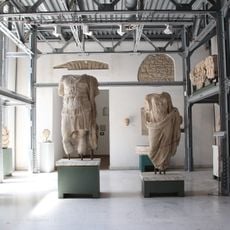
The former monastery buildings, owned by the Province of Benevento, house the central seat of the Museo del Sannio; the bell tower belongs to the city, while the church is a working parish. The cloister is reached from the entrance to the left of the church. The 1951 restoration removed the 18th-century side chapels and reopened the three apses, so the interior is best read by walking the perimeter first.
The circular floor plan of the church follows the model of the Hagia Sophia in Constantinople, reproduced at a much smaller scale. This makes the building one of the few examples in early medieval Italy where Byzantine design ideas were directly applied.
The community of curious travelers
AroundUs brings together thousands of curated places, local tips, and hidden gems, enriched daily by 92,860 contributors worldwide.