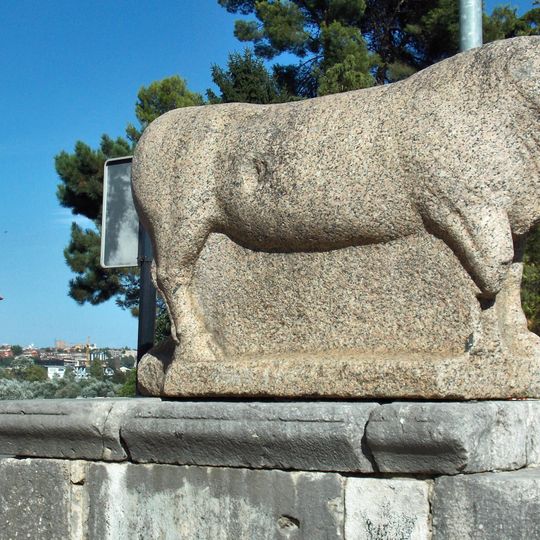
Bue Apis, Egyptian granite statue in Benevento, Italy
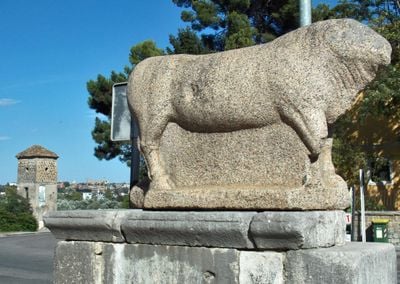
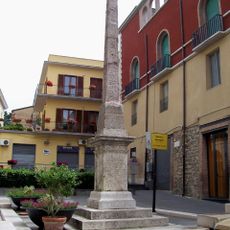
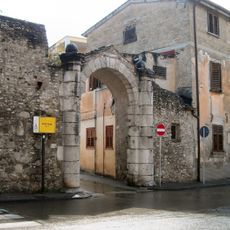
Bue Apis is a red Egyptian granite bull statue at the start of Viale San Lorenzo, outside the old city walls and facing the San Lorenzo gate. Wear has destroyed the upper head: ears and horns are entirely gone. The front legs are aligned, unlike Egyptian convention, and the genitals were never carved.
The red granite bull was unearthed in 1629 along the road to Casale dei Maccabei and placed by order of the Gonfaloniere and Consuls beside the entrance to Viale San Lorenzo, outside the walls and facing the San Lorenzo gate. The pedestal inscription, dated 1629, calls it a monument to Samnite military fortune, a Roman-era reading. In the 19th century Émile Étienne Guimet proposed it depicted the god Apis; Egyptologist Hans Wolfgang Müller later noted the absence of horns, sun disk and advanced left foreleg, questioning that identification.
Locals call the statue 'a ufara 'e Santu Lavrienzo', the buffalo of San Lorenzo, or simply 'il porchettello'. The Latin inscription carved on its pedestal in 1629 records it as a monument to the Samnite war fortune, showing how the city explained the find at the time.
The statue stands outdoors on a pedestal at the mouth of Viale San Lorenzo, just outside the old city walls and opposite the San Lorenzo gate, on the route toward the Madonna delle Grazie basilica. It can be viewed at any hour from the street. Look at the upper head: the ears and horns are entirely gone, worn away by exposure.
The statue's local nicknames are 'il porchettello' and, in Benevento dialect, ''a ufara 'e Santu Lavrienzo' — 'the buffalo of San Lorenzo'. The name misidentifies the animal, which is a bull, and ties the granite figure to the nearby basilica rather than to Egypt.
The community of curious travelers
AroundUs brings together thousands of curated places, local tips, and hidden gems, enriched daily by 94,554 contributors worldwide.