Municipal Aquarium, Public aquarium at Piazzale Mascagni, Livorno, Italy
The Municipal Aquarium in Livorno is a public museum building at Piazzale Mascagni that houses thousands of marine animals in different sections. The exhibition is organized into zones, with the Mediterranean section displaying tanks containing fish, rays, sharks, and coral formations found in local waters.
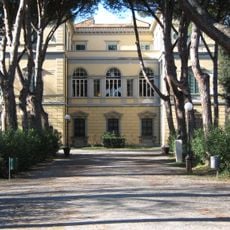
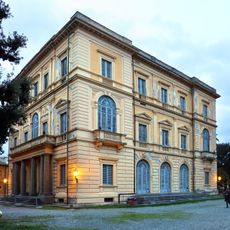
The building began as a heliotherapy asylum and was converted into an aquarium, inaugurated on 20 June 1937. Destroyed in the Second World War, it was rebuilt in 1950, enlarged in 1962 and from 1968 housed the Interuniversity Centre of Marine Biology, founded by the municipality and the universities of Bologna, Florence, Modena, Siena, Pisa and Turin. Vittorio Gregotti's late-1990s reconstruction, visited on site by President Carlo Azeglio Ciampi, was inaugurated on 31 July 2010.
The aquarium is named after Diacinto Cestoni, the Livorno-born naturalist and pharmacist (1637–1718) who studied marine organisms and corresponded with the physician Francesco Redi. The name links the facility to the city's scientific tradition. Since 1968 the building has also housed the Interuniversity Centre for Marine Biology, founded by Livorno and the universities of Bologna, Florence, Modena, Siena, Pisa and Turin.
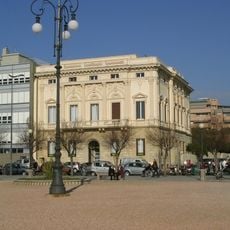
The aquarium stands at the edge of the Terrazza Mascagni seafront, on the stretch of lungomare reworked by Vittorio Gregotti between the Orlando shipyard and the terrace. The complex combines the original rectangular core with two apses, a semicircular extension and a cubic service building to the south. The sea-facing terrace covers about 1,000 m².
The aquarium holds a Greek-Roman marine archaeological area with a reproduction of a shipwreck, the only structure of its kind in Italy to include one. It is also the largest aquarium in Tuscany, with about 2,000 animals of over 300 species in 33 tanks as of 2014.
The community of curious travelers
AroundUs brings together thousands of curated places, local tips, and hidden gems, enriched daily by 94,401 contributors worldwide.