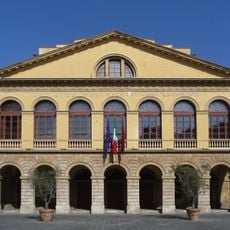
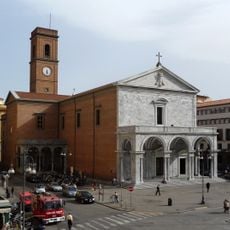
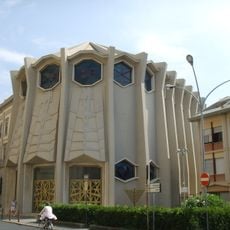
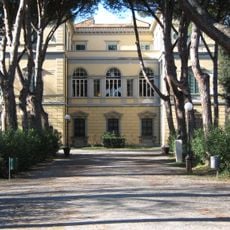
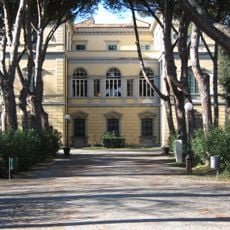
Villa Attias, Renaissance Revival villa in Livorno, Italy.
Villa Attias stood on the south-east side of today's Piazza Attias in Livorno. Of 17th-century origin, it was enlarged in 1871 by architect Antonio Cipolla, who added side wings forming a cour d'honneur. Its park held Luigi Brizzolara's fountain of Leda and the Swan, later moved to Villa Fabbricotti.
Villa Attias dates to the 17th century and belonged to the Opera del Duomo di Livorno; in the 18th century it was inhabited by the Jewish merchant Jasach Attias. In 1869 the Scaramangà family took over and in 1871 commissioned architect Antonio Cipolla to restore it, a project that enlarged the villa and added side wings forming a cour d'honneur. In 1888 it passed to Elisabetta Rodocanacchi, then to Irma Maniscalco, wife of Luigi Orlando.
The name Attias comes from the Jewish merchant family that lived here in the 18th century; the Opera del Duomo di Livorno owned the villa before them. In 1871 Antonio Cipolla's renovation added side wings that formed a cour d'honneur in front of the building. The Brizzolara fountain Leda and the Swan, placed in the park by consul Pedro Alessandro Bossio, was moved to Villa Fabbricotti park when the villa was demolished.
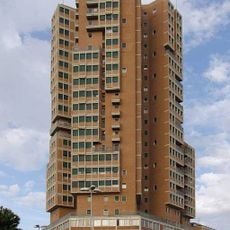
The villa was demolished starting in 1967 to build a new palazzo; the square was later extended southeast and equipped with an underground car park. The Brizzolara fountain was moved to Villa Fabbricotti park. The site is now Piazza Attias.
The Brizzolara fountain from the garden is the only surviving element from this lost residence. Today the sculpture stands in Villa Fabbricotti park, serving as a tangible link to the vanished architectural past.
The community of curious travelers
AroundUs brings together thousands of curated places, local tips, and hidden gems, enriched daily by 94,145 contributors worldwide.