Acropolis of Alatri, Archaeological site in Alatri, Italy.
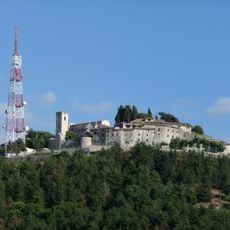
The Acropolis of Alatri is an ancient fortified site built with massive limestone blocks fitted together without mortar, featuring two gates called Porta Maggiore and Porta Minore. The structure sits on high ground and demonstrates the engineering skill of its builders, who constructed steep defensive walls using only hand tools and simple methods.
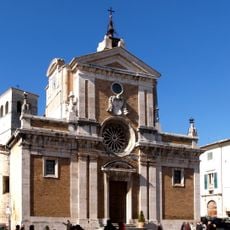
The dating of the polygonal walls is debated: the archaeologist Filippo Coarelli proposed the 4th–3rd century BC, others the 6th century BC or earlier, while Louis Charles François Petit-Radel placed the founding before 1539 BC. In the Middle Ages houses filled the acropolis until its destruction in 1326, after the expulsion of Francesco de Ceccano; only the cathedral and bishop's palace remained.
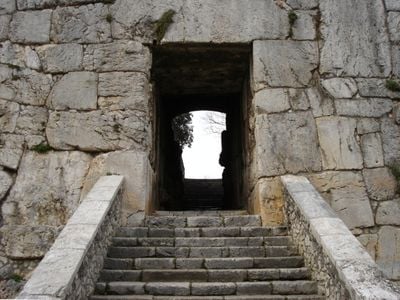
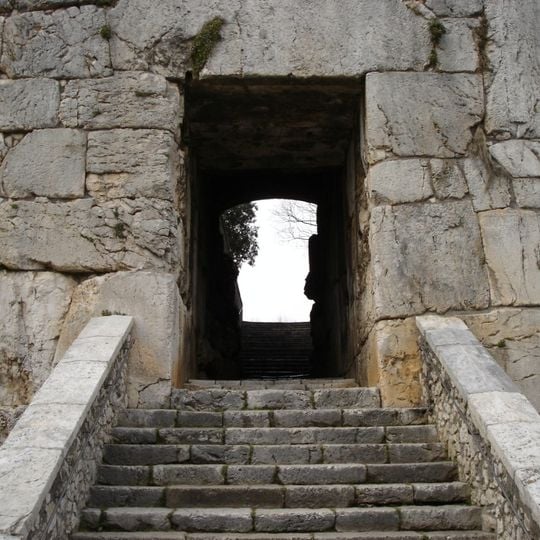
The name Porta dei Falli comes from three fertility symbols carved above the northern gate, now worn by time; travellers were once expected to climb its stairway without stopping. Inscriptions in the Oscan language remain visible at the upper left of the gate. The cathedral rests on the base of an ancient altar, part of whose polygonal masonry is still visible beneath the basilica's north side.
Access is through Porta Maggiore on the southern side, where the staircase leading to the gate dates from 19th-century reworkings; the acropolis sits at about 500 m above sea level on the hilltop. The two gates differ greatly in size: Porta Maggiore is 4.5 m high and 2.68 m wide, while Porta Minore measures only 2.12 by 1.16 m and opens onto a narrow rising corridor. The perimeter road, via Gregoriana, was laid out in 1843 when citizens cleared the walls for Pope Gregory XVI's visit.
The Porta Maggiore lintel is a single block measuring 4.0 × 5.13 × 1.3 m, estimated at 27 tonnes, second in Europe only to the Lion Gate at Mycenae. Holes in the architrave show where a gate or beams once closed it, and behind lies a dolmen-like gallery almost 11 m long.
The community of curious travelers
AroundUs brings together thousands of curated places, local tips, and hidden gems, enriched daily by 92,609 contributors worldwide.