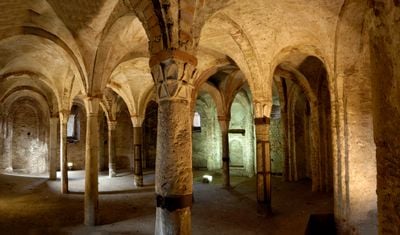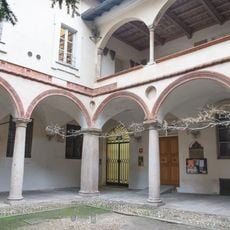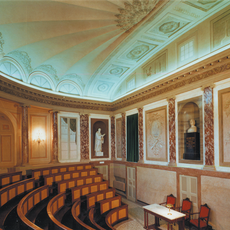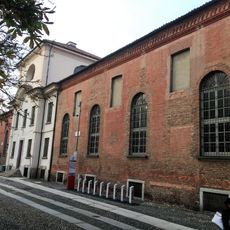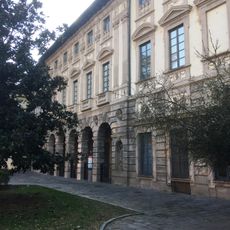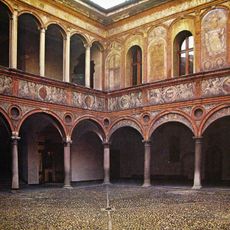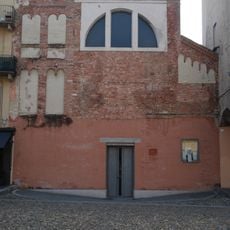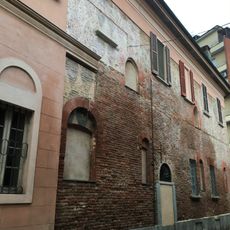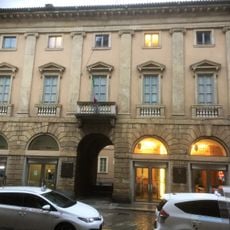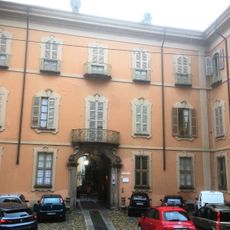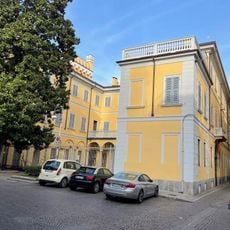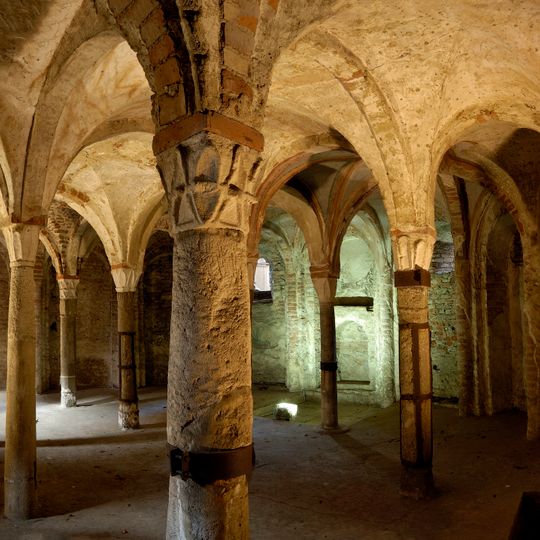
Sant'Eusebio, Medieval crypt beneath Piazza Leonardo da Vinci in Pavia, Italy.
Sant'Eusebio is a crypt, the only surviving part of a church demolished in 1923 to create Piazza Leonardo da Vinci. Its five naves are divided by four rows of columns carrying cross vaults, and the vaults keep Byzantine-style frescoes of busts of saints from the second half of the 12th century. The apse perimeter dates to the 7th century.
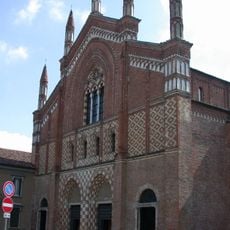
The site began as an Arian cathedral during the Ostrogothic period. Lombard King Rothari transformed the structure between 636 and 652, marking a shift in religious and political control in the region.
The name Sant'Eusebio refers to Eusebius of Vercelli, to whom the church was dedicated. The surviving Lombard capitals imitate jewellery: one is divided into triangular fields like contemporary cloisonné fibulae, another has longitudinal ovals compared to water leaves and derived from "cicada" fibulae of barbarian goldwork. Traces of glass paste or coloured stones were thought to cover them.
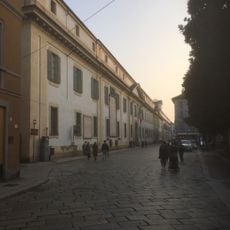
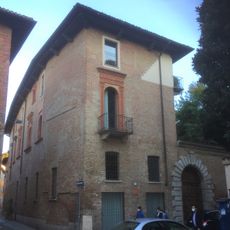
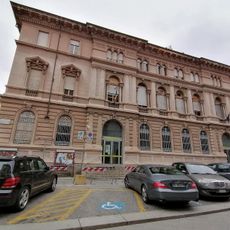
The crypt is entrusted to the Civic Museums of Pavia, and access requires booking a visit through them in advance. The site lies beneath Piazza Leonardo da Vinci, where the church once stood before its 1923 demolition.
During 1968 restoration work, workers discovered early medieval tombs in the eastern section of the crypt. These findings provided clues about burial practices and the importance of this place in the region.
The community of curious travelers
AroundUs brings together thousands of curated places, local tips, and hidden gems, enriched daily by 94,319 contributors worldwide.