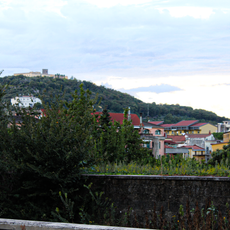
Convento di Sant'Antonio, Gothic monastery and basilica in Nocera Inferiore, Italy.
The Convento di Sant'Antonio stands at the top of the largo of the same name on the southern slope of the Parco hill in Nocera Inferiore, above a monumental white stone staircase rebuilt in the early 19th century. Its grey tuff portico has round arches on square pillars with foliate capitals, and the church interior, remodelled by Giovanni Rosalba between 1829 and 1831, is covered by a barrel vault on eight paired pillars.
The monastery traces its origins to Guido Filangieri, with construction starting in 1256 on the site of an earlier sanctuary dedicated to Saint Catherine. The complex evolved over time into a major center of religious and scholarly activity in the region.
The church is dedicated to Saints Francis of Assisi and Anthony of Padua, though it was originally dedicated to Saint Francis alone. The Carafa-Castriota Scanderbeg family financed its 16th-century enlargement, and their coats of arms are carved at the base of the pillars beneath the Gothic crossing. The Arciconfraternita dell'Immacolata Concezione in Sant'Antonio oversaw restorations in the 17th and 18th centuries.
The church is reached by a monumental white stone staircase restored in the first half of the 20th century, leading to a grey tuff portico with round arches on square pillars. Inside, the floor was raised 79 cm in the 1829–1831 works, so the 1546 wooden door now sits above the springing of the Gothic entrance arch. The convent rooms lie off the church and cloister.
In 1385, the monastery halls hosted a conspiracy against Pope Urban VI, revealing its involvement in significant ecclesiastical political affairs. This episode shows that the complex was not just a spiritual center but also a place where church politics unfolded.
The community of curious travelers
AroundUs brings together thousands of curated places, local tips, and hidden gems, enriched daily by 92,641 contributors worldwide.