Area archeologica la Fenice, Archaeological site in Senigallia, Italy
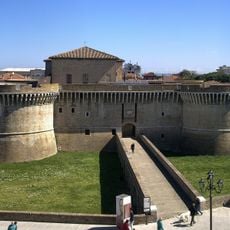
Area archeologica la Fenice is a musealized excavation beneath the La Fenice theatre in Senigallia, entered through a passage in the 16th-century walls built by Duke Guidobaldo II Della Rovere. At its centre a cardo and decumanus cross, their paving worn by chariot wheel ruts; tabernae stand on one side and a domus with cocciopesto floors and an impluvium on the other.
Senigallia, the Roman Sena Gallica, was the first Roman colony on the Adriatic coast, founded in the early 3rd century BC among the Senones Gauls. The site's remains came to light in 1989 during foundation work for the new La Fenice theatre, exposing structures dated to the 2nd–3rd century AD. Excavations also found 130 medieval tombs, one left visible for teaching.
The site lies beneath the La Fenice theatre, entered through a passage cut in the mid-16th-century walls built by Duke Guidobaldo II Della Rovere. Finds from the city's excavations over the past century are displayed in labelled cases along the walkways. The name Sena Gallica recalls the Senones, the Gauls who held this area in the 4th century BC.
The site lies under the La Fenice theatre and is reached through a passage opened in the mid-16th-century walls built by Duke Guidobaldo II Della Rovere. Visitors walk on raised walkways a few metres below street level, past display cases along the route. The excavated ground and Roman paving are uneven, so sturdy shoes help.
Around 130 medieval graves rest in their original positions on the site, offering direct evidence of continuous habitation over time. These burials show that the land remained in use for this purpose even after the Roman period ended.
The community of curious travelers
AroundUs brings together thousands of curated places, local tips, and hidden gems, enriched daily by 93,242 contributors worldwide.