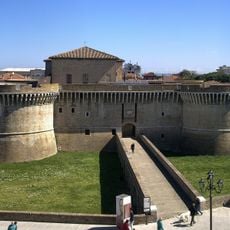
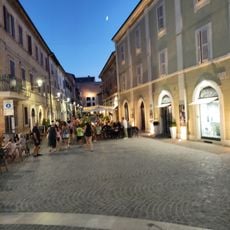
Palazzetto Baviera, Renaissance palace in Senigallia, Italy
Palazzetto Baviera is a Renaissance palace in Senigallia featuring a harmonious courtyard enclosed by two tiers of columns and a central well. The well is adorned with the coats of arms belonging to the Baviera family.
The building dates to the 14th century and was remodelled in the later 15th century when Giovanni Giacomo Baviera settled here. In 1474 Pope Sixtus IV sent him to Senigallia to take possession of the Rocca on behalf of his nephew Giovanni della Rovere, the new lord; he arrived on 23 October and was handed the city keys. The Baviera became owners in 1512, and the last descendant, Barbara Marazzani Baviera Benedetti, donated the palace to the municipality in 1947.
The five upper-floor rooms carry stucco vaults made by Federico Brandani of Urbino between 1560 and 1562 for Giuseppe Baviera, confidant of Duke Guidubaldo II Della Rovere. The reliefs show the Old Testament, the twelve labours of Hercules, the Iliad and episodes of republican and imperial Rome. The main hall is called the Sala della Guerra di Troia.
The palace stands on the right side of Piazza del Duca, on the river side of the square, and has been open to the public as a house-museum since 2017. The ground floor holds offices and two exhibition rooms with painted wooden coffered ceilings, while the Brandani stucco rooms are on the upper floor. The inner courtyard, with its round well bearing four Baviera coats of arms, is reached from the square.
The stucco cycle was made by Federico Brandani of Urbino between 1560 and 1562 for Giuseppe Baviera, captain of the Senigallia fair and superintendent of the city fortifications. The 1930 earthquake brought down a corner of the Troy War ceiling; restorer Alberto Moroni began with that room.
The community of curious travelers
AroundUs brings together thousands of curated places, local tips, and hidden gems, enriched daily by 93,009 contributors worldwide.