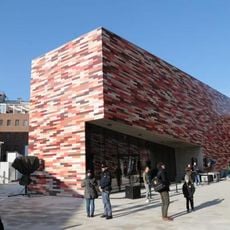
Castello di Mestre, Medieval castle in Mestre, Italy.
Castello di Mestre is the name of two vanished fortresses, Castelvecchio and Castelnuovo. Castelvecchio stood in the 11th century where the two arms of the Marzenego separate, near today's former Umberto I hospital; Castelnuovo, begun by Venice after 1337, lay east of it, had at least 11 towers and three gates, and was ringed by a moat fed by the Marzenego.
Castelvecchio was built in the 11th century by the Bishops of Treviso where the two branches of the Marzenego separated; a papal bull of 1152 confirmed Bishop Bonifacio's ownership of castle, port and village. Ezzelino da Romano took it around 1245, a fire nearly destroyed it in 1274, and Venice seized it on 29 September 1337, then began Castelnuovo. Abandoned, it was replaced by a monastery built between 1468 and 1470.
The name Mestre Fidelissima, granted by Venice for the city's resistance during the 1513 French assault, survives in local usage. The Torre dell'Orologio, the old Porta di Borgo, still marks the former southern gate where tolls were collected from traders entering the castle.
Both fortresses are gone: Castelvecchio stood where the ex-Ospedale Umberto I now stands, reached from the Terraglio through today's via Castelvecchio; Castelnuovo lay east of it, around today's Torre dell'Orologio, the surviving Porta di Borgo. Only that clock tower and the foundations of the Torre Belfredo, demolished in the 19th century, remain to be seen.
The two fortresses shared one name: both Castelvecchio and Castelnuovo were called "castello di Mestre". Castelnuovo had at least eleven towers and three gates, Porta Altino, Porta Belfredo and Porta di Borgo, where tolls were collected from merchants. Its perimeter exceeded one kilometre.
The community of curious travelers
AroundUs brings together thousands of curated places, local tips, and hidden gems, enriched daily by 94,645 contributors worldwide.