Castello di Monreale, Medieval castle in Faedo, Italy.
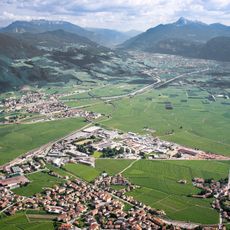
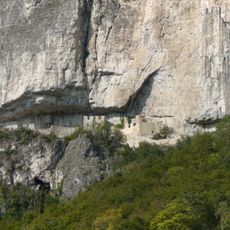
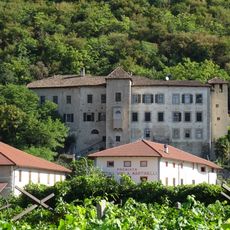
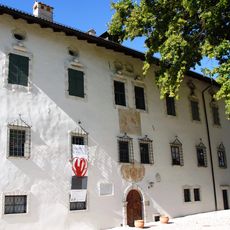
Castello di Monreale stands above Faedo, a hamlet of San Michele all'Adige, on the site of a high-medieval castle first documented in 1238 as castrum regalis. Repeated rebuilds left a large tower on a hexagonal plan and a crenellated curtain wall. Inside, the south and east palazzi keep a knights' hall with an open marble fireplace bearing the Thun-Neudeck alliance coat of arms, three-light triforium windows, and a chapel painted with 16th-century frescoes.
The castle was first documented in 1238 as castrum regalis and was built by the Counts of Eppan as a secondary stronghold. In 1243 the Brixen prince-bishop Egno of Eppan held it as a fief of the Bishopric of Trent; in 1276 it passed as a fief to Count Meinhard II of Gorizia-Tyrol and from 1363 to the Habsburgs. Between 1508 and 1559 the brothers Christoph and Bernhard, then Sigmund von Thun, rebuilt the dilapidated castle as a Renaissance palace.
The castle's name appears in a medieval fresco in the church of Sant'Agata in Faedo, and it also appears in the name of the Comunità di Valle Rotaliana-Königsberg and in the business names of several companies on the Rotaliana plain. The German name Königsberg means "king's mountain".
The castle remains in private ownership with access restricted to special occasions and events organized by the owner. Planning a visit requires contacting ahead to learn about specific dates when the site is open to visitors.
The castle appears in a medieval fresco in the church of Sant'Agata in Faedo, which shows the building as it looked centuries ago. Its German name, Königsberg, also appears in the title of the Rotaliana-Königsberg valley community and in the names of several businesses on the Rotaliana plain.
The community of curious travelers
AroundUs brings together thousands of curated places, local tips, and hidden gems, enriched daily by 94,498 contributors worldwide.