Castello di Oria, Medieval castle in Oria, Italy.
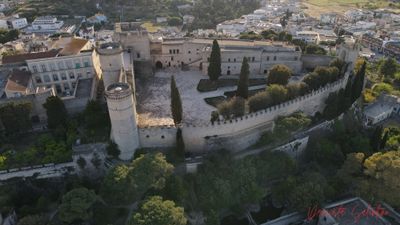
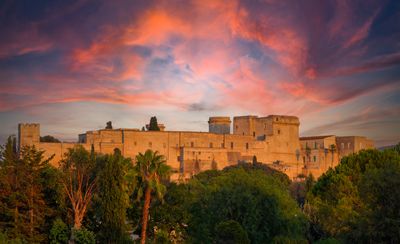
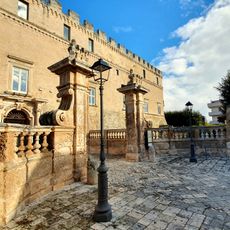
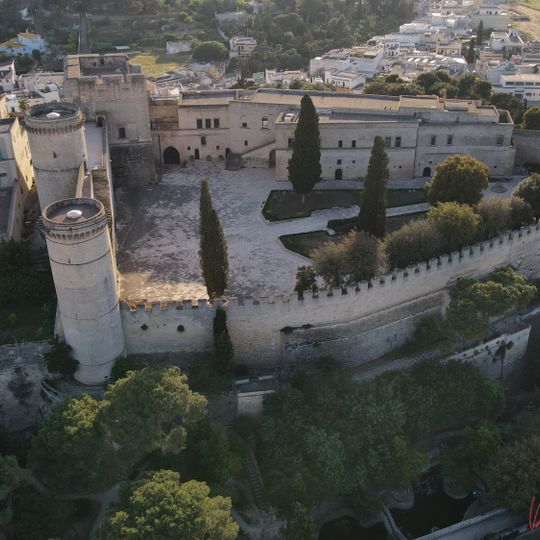
Castello di Oria stands on the Vaglio hill about 166 m above sea level, the highest point of Oria. Its plan is an isosceles triangle with the Torre dello Sperone at the northern apex, the Mastio or Donjon in the south, and the cylindrical Torre del Salto and Torre del Cavaliere. The walls are of pale beige and light grey stone, with crenellations, small window slits and cannon ports still visible.
The site was occupied by the Messapic acropolis, probably walled by the 6th century BC. A first fortified core, likely the square tower, is assumed for the early Middle Ages; the Normans held Oria in the 11th century. Frederick II enlarged and adapted the castle between 1225 and 1233, and it hosted guests at his marriage to Isabella II of Jerusalem. Angevin work added the cylindrical towers called del Salto and del Cavaliere.
The castle is called "svevo" after Frederick II, who enlarged it between 1225 and 1233 and hosted his wedding guests here; the square Torre dello Sperone and the scarped Mastio keep Guelph merlons and arrow slits. Since 2 July 2007 it has been privately owned and has rarely opened to the public.
The site is accessed through Oria's historic center on foot from the town's central area. Visiting typically requires planning around special events and seasonal openings, so checking local schedules beforehand makes sense.
The castle's plan is an isosceles triangle with its apex pointing north, formed by the Torre dello Sperone. The southern Mastio has a battered, sloping base that exposed besiegers to fire from above; similar towers stand at Mesagne and Galatone. A walled-up doorway may mark the original drawbridge entrance.
The community of curious travelers
AroundUs brings together thousands of curated places, local tips, and hidden gems, enriched daily by 92,608 contributors worldwide.