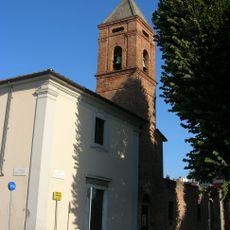
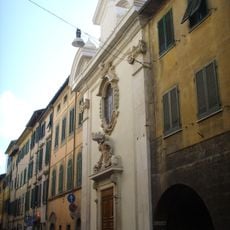
Cappella di Sant'Agata, Romanesque chapel near San Paolo a Ripa d'Arno, Pisa, Italy.
Cappella di Sant'Agata is an octagonal brick structure standing near San Paolo a Ripa d'Arno church in Pisa. The building displays triple-divided windows with marble columns, decorative arches, and a pointed roof that rises above the surrounding area.
The chapel's founding is traditionally dated to 1063, after Pisan raids on Palermo and Catania brought the cult of Saint Agatha to the city. Vallombrosan monks of San Paolo a Ripa d'Arno built it in the first half of the 12th century; the first written record is from 1132. Its octagonal plan and resemblance to the Holy Sepulchre and the Baptistery suggest the architect Diotisalvi. American bombing in 1943 damaged the abbey complex, and later demolitions removed the surrounding medieval buildings.
The chapel is dedicated to Saint Agatha, patron saint of Catania. Devotion in Pisa is documented from 1126, when Pope Honorius II granted the archbishop the use of the pallium on her feast day, 5 February. On that day the reputed skull of the saint, kept in the sacristy of San Paolo a Ripa d'Arno, was displayed in its reliquary, drawing many nursing mothers.
The chapel stands in a public green area on via San Paolo, no longer enclosed by the medieval abbey courtyard that once surrounded it. It belongs to the Comune di Pisa and was restored between 2020 and 2022. Look for the octagonal brick building beside San Paolo a Ripa d'Arno; the apse layout is now visible because the adjoining structures were demolished after 1943.
The octagonal plan, the resemblance to the Holy Sepulchre church and to the Baptistery, and the 12th-century date lead scholars to attribute the chapel to the architect Diotisalvi. Inside, under some of the small arches, 12th-century wall decorations survive.
The community of curious travelers
AroundUs brings together thousands of curated places, local tips, and hidden gems, enriched daily by 92,634 contributors worldwide.