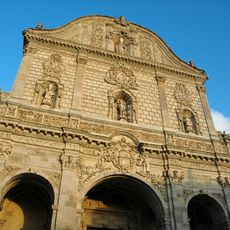
San Pietro di Silki, Romanesque church in Sassari, Italy.
San Pietro di Silki is a church in Sassari with a 17th-century facade divided into three parts by four pilasters and topped by a lunette. A round arch bearing the coat of arms of Antonio Mereu leads into a portico whose upper level holds the cantoria. The single nave has a barrel vault and four chapels along the left wall; the first two orders of the bell tower and some wall sections date to the 13th century.
Founded between 1065 and 1082 on the site of the village of Silki, the church was attached to a Benedictine abbey. The Condaghe di San Pietro di Silki records the monastery between the 11th and 13th centuries. Rebuilt in Romanesque style in the 13th century, it was ceded to the Observant Franciscans in 1467 by Archbishop Antonio Cano and the city authorities.
The first chapel on the left, dedicated to the Madonna delle Grazie, was built between 1472 and 1478 in Gothic-Catalan style and belongs to the Gremio dei Massai Agricoltori, the farmers' guild. Its oldest bay has a ribbed cross vault on carved capitals, and the guild's 19th-century candlestick is carried each year in the Faradda, Sassari's descent of the candlesticks.
The building can be explored easily due to its manageable size and simple layout, making it accessible for most visitors. Plan 30 to 45 minutes to view the facade, interior, and individual chapels at a relaxed pace.
The second Baroque retablo, dedicated to Saint Salvatore da Horta, holds a reliquary with the saint's uncorrupted heart and a 15th-century Madonna del Fico, a wooden statue from an Iberian workshop. The main gilded wooden altar of the 18th century displays statues of Saint Peter and the Madonna delle Grazie.
The community of curious travelers
AroundUs brings together thousands of curated places, local tips, and hidden gems, enriched daily by 93,975 contributors worldwide.