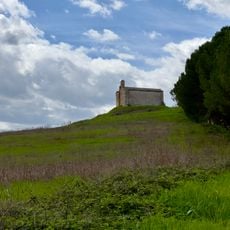
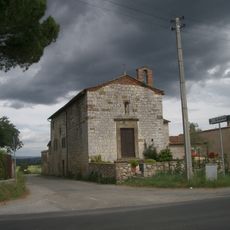
San Niccolò, Romanesque church in Casole d'Elsa, Italy
San Niccolò is a church built by reassembling the crypt of Casole's Collegiate Church, which was transformed in Gothic style in the 13th century; its interior measurements match those of that crypt exactly. Inside, a cross-vaulted apse transept is divided into five naves by round arches on columns, with two semicircular apses set into the walls and invisible from outside. The facade is dominated by a portico, and the 17th-century fresco decoration is by Francesco Rustici, known as il Rustichino.
San Niccolò is first recorded on 17 June 1348, when Guazzolino del Gorda gave 10 soldi for images of saints to be painted; the frescoes were only made three centuries later. By 6 November 1386 a Societas Sancti Nicolai existed, to which Ghita del fu Maffeo da Cavallano donated relics. A 1423 visitation found two altars, and in 1576 the Societas Beate Marie Virginis, with 200 members, paid for the facade portico and a bell tower destroyed in World War II and rebuilt.
The interior holds a 14th-century painting from the Sienese School positioned at the main altar, reflecting the region's artistic traditions. This work draws visitors interested in medieval art and remains a focal point of the worship space.
The church stands a few hundred metres from the centre of Casole d'Elsa, so it is reached on foot or by a short drive rather than in the middle of the village. It now serves as the cemetery chapel, and the cemetery occupies ground already used for Etruscan burials. Look for the three portals of the facade, the central one crowned by a worn arch on two corbels.
The church was built by reassembling the crypt of Casole's Collegiata, which was moved when that church took on Gothic forms in the 13th century; the interior measurements match the crypt exactly. A 13th-century processional cross is kept here, and a fresco decorating a tomb, found at the start of the 20th century, suggests the building served as a cemetery chapel from the outset. The cemetery occupies ground already used for Etruscan burials.
The community of curious travelers
AroundUs brings together thousands of curated places, local tips, and hidden gems, enriched daily by 93,084 contributors worldwide.