Sant'Agostino, Romanesque Catholic church in Arezzo, Italy
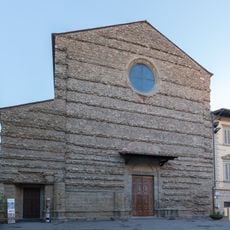
Sant'Agostino is a church on the piazza of the same name in Arezzo. Its exterior keeps the fifteenth-century facade in dressed stone and a tall square bell tower, whose top was rebuilt after a lightning strike in 1825. The interior was halved and remodelled between 1761 and 1766, so the present single hall with stucco decoration replaces the earlier three-nave layout.
The Augustinian Hermits, approved by Pope Alexander IV in 1256, laid the first stone of Sant'Agostino in 1257. A larger three-nave church was begun in 1330 and was among Arezzo's largest by 1341. Bequests from Mariotto di Cristoforo Cofani and his sons allowed work to resume and finish from 1491. In 1761–1766 a rebuilding by Filippo Giustini halved the church and gave it its Baroque and Rococo interior.
The church takes its name from the Augustinian Hermits, approved by Pope Alexander IV in 1256; the friars laid the first stone the following year. Tradition holds that Martin Luther, still an Augustinian monk, stayed in the convent in 1510 on his way to Rome. Inside, look for the 1771 wooden choir carved by Ludovico Paci in the apse.
The church stands on Piazza Sant'Agostino, the square of the same name, not on Via Garibaldi. The facade in pietre conce and the tall quadrangular bell tower, both 15th-century, face the square and make the building easy to pick out when walking the streets around it.
The church keeps the fragmented Circoncisione di Gesù (1506), painted by Niccolò Soggi, Domenico Pecori and Fernando De Coca. A Lucchese thief stole it in 1922 and cut it into five pieces to sell separately, but was caught; three parts were later stolen by the art dealer Ildebrando Bossi.
The community of curious travelers
AroundUs brings together thousands of curated places, local tips, and hidden gems, enriched daily by 93,013 contributors worldwide.