Roman Amphitheatre of Arezzo, Roman amphitheatre at Via Crispi, Arezzo, Italy.
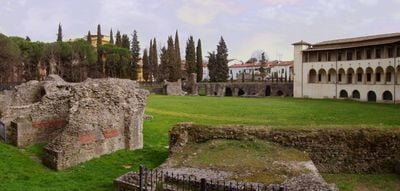
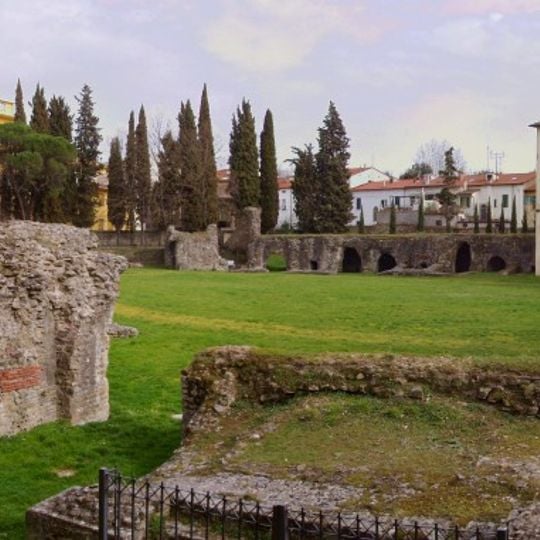
The Roman Amphitheatre of Arezzo is an elliptical structure measuring 121 by 68 metres, built in the 2nd century AD in the south of Arezzo's walled city. Its arena, 71.9 by 42.7 metres, was only slightly smaller than the Colosseum's. The seating tiers are gone, but the travertine stairs, vaulted vomitoria, and remains of the annular corridors survive, along with a jagged masonry fragment with a patch of red brick.
The amphitheatre was built between the late 1st and early 2nd century AD, dated to the reign of Hadrian (117–138). It was first excavated in 1914–1915, work interrupted by war and resumed in 1926; since 1950 periodic restorations have brought it fully to light. Over the centuries it suffered heavy stone-robbing, and material was reused for religious buildings, notably the 16th-century Monastery of San Bernardo built against the south hemicycle.
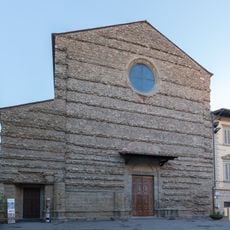
The site sits right next to the Monastery of San Bernardo, which now houses an archaeological museum with objects found in and around the city. Pottery, sculptures, and everyday items on display there give a concrete sense of what Roman Arezzo looked like.
The site is in the center of Arezzo and easy to reach on foot from the old town. The ground is uneven throughout, so sturdy footwear makes the visit more comfortable, especially inside the old passageways.
The arena measured 71.9 by 42.7 metres, only slightly smaller than the Colosseum's 77 by 46.5 metres, while the wall band around it was just 24.7 metres thick. The interior stairways were cut from travertine, and the outside of the building was probably faced with local sandstone.
The community of curious travelers
AroundUs brings together thousands of curated places, local tips, and hidden gems, enriched daily by 93,367 contributors worldwide.