Santa Margherita, Former church in Dorsoduro, Venice, Italy
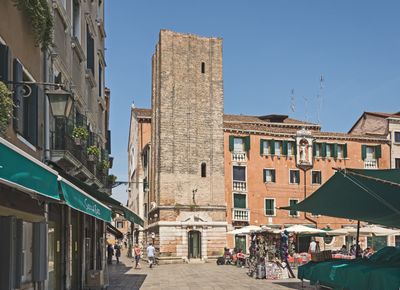
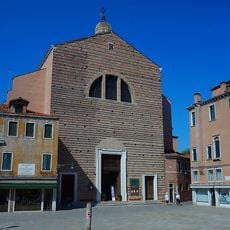
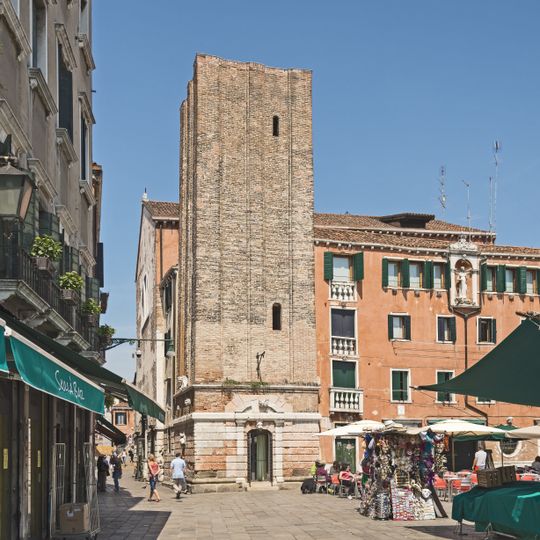
Santa Margherita is a deconsecrated church in Dorsoduro, set on the north side of Campo Santa Margherita with its plain gabled facade facing the narrow Calle de la Chiesa. The single nave was shortened in the early 1900s to make room for a cinema foyer and three tiers of loggias, and the presbytery became a stage. The adjoining bell tower is truncated: its upper half was demolished in 1808, leaving the entrance portal and two slit openings.
A tradition holds that the church was founded by Geniano Busignaco under Doge Pietro Tradonico and consecrated in 853 by Bishop Mauro of Castello. It was a pieve and later a collegiate church. The parish was suppressed in 1810 under Napoleon's Kingdom of Italy, and the building became a tobacco warehouse, then a marble depot in 1839, sculptor Luigi Borro's studio from 1861, an evangelical temple from 1882, the Camera del Lavoro in 1910, and a cinema from 1921 to 1977. Ca' Foscari University bought it in 1987 and opened the auditorium in 1994.
The church is named after Saint Margaret of Antioch, whose martyrdom is depicted in the fresco on the vault by Antonio Zanchi. Since 1994 the deconsecrated building has housed Ca' Foscari University's Auditorium Santa Margherita; its first concert there was Pergolesi's La serva padrona, directed by Marco Bellussi.
The building sits centrally on Campo Santa Margherita and is easy to reach on foot by following main routes through Dorsoduro. The interior is bright and spacious, with clear sightlines that make orientation straightforward.
A large painting by Antonio Zanchi hangs from the ceiling depicting the martyrdom of Saint Margaret, preserving the site's religious history. This artwork connects the former sacred function with today's academic life happening beneath it.
The community of curious travelers
AroundUs brings together thousands of curated places, local tips, and hidden gems, enriched daily by 92,954 contributors worldwide.