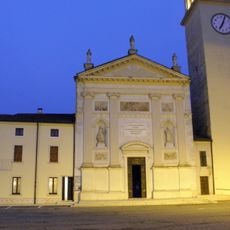
San Salvaro, Romanesque church in Legnago, Italy.
San Salvaro is a Romanesque church with three naves and three apses, now enclosed by the built-up area of the hamlet of San Pietro di Legnago. Its crypt, the oldest part, holds Corinthian capitals reused from Roman and Lombard material. On the north wall a stone inscription records the founding date of 1117.
The building dates to 1117, erected by order of Countess Matilda of Canossa; its style, materials and a stone inscription on the north wall confirm this. The crypt is older: Renato Sandrini's studies describe it as a rebuild of a 6th-century church that stood on a pagan shrine. In the 19th century the church risked demolition before the state property office gave it to the local community.
The apse fresco of the Transfiguration is by Luigi del Pozzo, flanked by the Annunciation with the archangel Gabriel on the left and Mary on the right; a damaged God the Father appears in the tympanum. In the crypt, the Madonna dei flagellanti was painted by Charlie and Barbara Lovato and consecrated by Verona's bishop Giuseppe Carraro in September 2001, replacing an earlier fresco ruined during the 1902 restoration.
The church stands in the centre of the San Pietro di Legnago hamlet, now surrounded by urbanisation, so it is reached on foot from the village streets rather than by country roads. The crypt, the oldest part, was buried in the Baroque period and made unreachable by two side staircases from the pleban church to the presbytery; the 1902 restoration by curate Giuseppe Trecca brought it back into use. Look for the traces of the large windows he closed, still visible in the walls.
The church's crypt holds Corinthian capitals reused from Roman buildings, and the walls contain Lombard material as well. The 1117 date rests on a stone inscription on the north wall, which visitors can look for outside.
The community of curious travelers
AroundUs brings together thousands of curated places, local tips, and hidden gems, enriched daily by 92,859 contributors worldwide.