Collegiata di Castell'Arquato, Romanesque collegiate church in Castell'Arquato, Italy
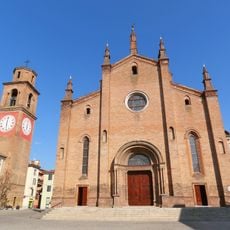
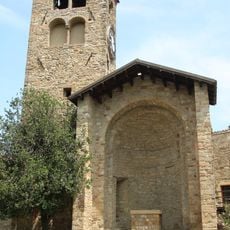
The Collegiata di Castell'Arquato, also known as Santa Maria Assunta, is a Romanesque church built of sandstone with a facade featuring a round-arched portal, a small bifora above it, and three cross-shaped openings. Its interior has figured 12th-century capitals and side chapels, including the 15th-century Cappella di Santa Caterina with Tuscan-school frescoes. The main altar incorporates five 13th-century panels.
A plebeian church with a baptismal font from the 7th–8th century preceded the current building; a document from the 8th century records that the noble Magno built the pieve between 756 and 758 and donated it, with the castle and village, to the bishop of Piacenza on his death in 789. The earthquake of 1117 destroyed that church, and the present one was built on its remains and consecrated in 1122. The bell tower was added in the 13th century, the cloister at the end of that century, and the Chapel of Saint Catherine in the early 15th century.
The chapel of Saint Catherine of Alexandria was added in the early 15th century and frescoed by an unknown Tuscan-school painter with the cycle of the Passion of Jesus, the funeral of the Virgin Mary and her Glory. The frescoes were rediscovered in 1899, when restorations under archpriest Cagnoni brought them back to light.
The church is open daily, though visiting hours change depending on the season with shorter times in winter months. Coming early or checking exact times beforehand helps you avoid disappointment.
The immersion baptismal font in the fourth small apse dates to the 7th–8th century and was restored in the 1930s after falling out of use following the 15th century. It is the oldest surviving element of the earlier pieve destroyed by the 1117 earthquake.
The community of curious travelers
AroundUs brings together thousands of curated places, local tips, and hidden gems, enriched daily by 94,652 contributors worldwide.