Forte Lugagnano, Military fort in Verona, Italy.
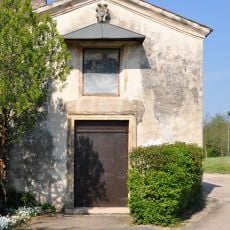
Forte Lugagnano is a polygonal fort with a central reduit, built in open countryside west of Verona. Its two-storey reduit has rounded corners and a casemated roof; the inner courtyard facade shows lowered bifora windows, while the outer front has two tiers of loopholes. The entrance is reached by a drawbridge and splits before a rounded gorge caponier toward two symmetrical arched portals.
Forte Lugagnano was built between 1860 and 1861 as Werk Kronprinz Rudolf, part of Verona's second entrenched field, laid out between 1859 and 1866. Work was directed by the Imperial Royal Fortifications Office of Verona, not by a private captain. It was named after Archduke Rudolf of Habsburg-Lorraine, Austrian crown prince, who died at Mayerling.
The fort displays the defensive design choices typical of 19th century military engineering, with thick walls and carefully positioned firing openings. Visitors can trace how soldiers moved through the spaces and organized their daily duties in such a fortified structure.
Access to the fort requires climbing an earthen embankment surrounding the entire structure, so sturdy footwear and basic fitness are helpful. The passages inside are narrow and low-ceilinged, so take time to move carefully and watch your head.
The fort was strategically positioned to monitor the Milan-Venice railway line, one of the 19th century's most important transportation routes. This placement reveals how new transport networks directly influenced where military planners chose to build fortifications.
The community of curious travelers
AroundUs brings together thousands of curated places, local tips, and hidden gems, enriched daily by 93,140 contributors worldwide.