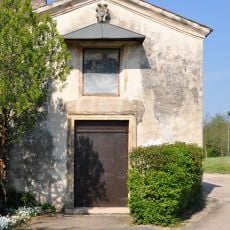
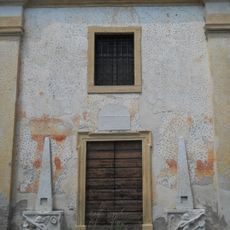
Villa Marioni Pullè, Neoclassical villa in Chievo, Verona, Italy.
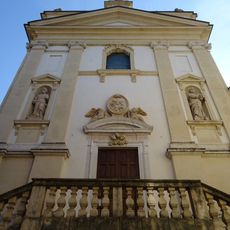
Villa Marioni Pullè is a neoclassical estate in Chievo featuring classical architectural elements such as curved and triangular pediments, columns, and arched galleries across its elegant facade. The main building of considerable height is flanked by lateral wings displaying varied architectural styles.
The first villa on the site dates from the 17th century, when Veronese merchants built country houses in Chievo. In the 1780s the Pellegrini family commissioned architect Ignazio Pellegrini to rebuild it as a classicist residence with two large side wings, a portico and statues of Greek gods on the top floor. After the fall of the Venetian Republic the villa stood empty at Napoleon's request. Count Leopoldo Pullè bought it in 1873 and revived its theatre; in 1919 it was sold to a pension fund and later became a children's sanatorium.
The villa's name joins three families: the Pellegrini, who commissioned Ignazio Pellegrini's 1780s rebuilding, the Marioni, who lived here next, and the Pullè, owners from 1873. Count Leopoldo Pullè revived the small theatre of the Marioni era for plays and chamber concerts, and in 1897 he received King Umberto I, whose visit is recorded in photographs of the salons hung with Italian flags and in the banquet menu kept from the occasion.
The complex is visible from ground level and can be viewed from the outside, with the various architectural styles and overall layout offering good perspectives. It is best visited during daylight hours to clearly see the details of the facade and the proportions of the wings.
King Umberto I of Savoy stayed here during military maneuvers in 1887 and again in 1897, anchoring its connection to Italian royalty. A monarch's visit during this period was an affirmation of the family's elevated social standing.
The community of curious travelers
AroundUs brings together thousands of curated places, local tips, and hidden gems, enriched daily by 93,141 contributors worldwide.