Fortezza Nuova, Fort in Livorno, Italy
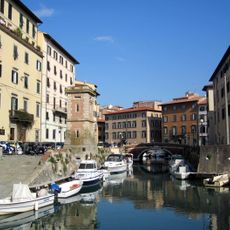
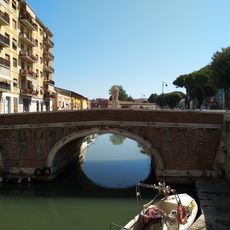
Fortezza Nuova stands on an island in a large water basin, linked to Livorno by a small bridge and recent floating pontoons. Its curtain wall, largely intact, has concave retired flanks, carved embrasures and a pronounced ravelin facing the water. The main entrance is protected by an enclosure topped with corner turrets; a gallery leads to the bastion's upper levels, where service buildings ruined in the Second World War now sit within a public park.
Construction began on 10 January 1590 with the laying of the first stone, adapting two bastions of Buontalenti's pentagonal plan, San Francesco and Santa Barbara. The design came from Buontalenti with Don Giovanni de' Medici and engineers Claudio Cogorano and Alessandro Pieroni. By the late 17th century about two-thirds of the complex was demolished, leaving only the Bastione San Francesco and freeing land for the Venezia Nuova district.
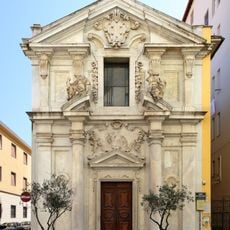
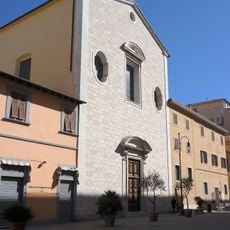
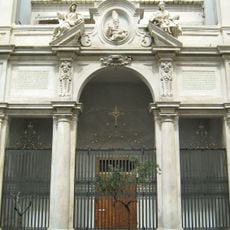
The fortress contains a church dedicated to the Immaculate Conception and now serves as a public park where concerts, exhibitions, and theater performances take place regularly. Visitors experience a space where historical walls and modern cultural activities coexist.
Visitors can walk through the fort freely and enjoy elevated views of the harbor and surrounding areas from the ramparts. The park is open to the public and features pathways that allow exploration of the structure and its canals from different angles.
Until the early 20th century a cannon stood on the central terreplein and was fired to announce midday, recalling Livorno's resistance to Austrian troops in May 1849. A naval cannon still points toward the new Porta San Marco.
The community of curious travelers
AroundUs brings together thousands of curated places, local tips, and hidden gems, enriched daily by 92,832 contributors worldwide.