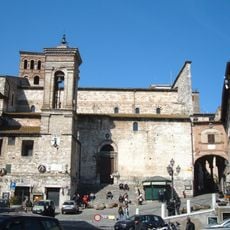
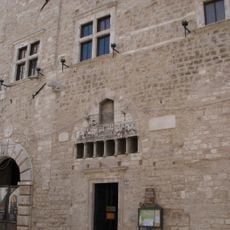
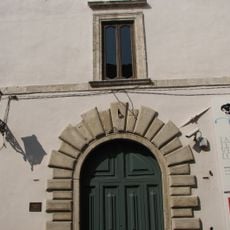
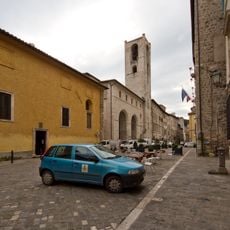
Fonte Feronia, Roman fountain in Narni, Italy.
Fonte Feronia is a water source of pre-Roman origin in Narni, reached by a rock-cut tunnel dated by its construction technique to between the 4th and 3rd centuries BC. The spring was dedicated to the goddess Feronia, and a marble carved with a large flame is set in the fountain. A plaque inside records the restoration completed in 1609.
The site was a pre-Roman spring dedicated to the goddess Feronia, worshipped by Umbrians, Etruscans, Volsci and Sabines. Local speleologists dated the water tunnel to between the 4th and 3rd centuries BC. The first written record is a 1128 Farfa register naming the "maccla mortua quae vocatur Ferone", donated by the Narni nobleman Beraldo di Rolando. The fountain was restored in 1582 under governor Giulio Ranuzi, with a plaque recording completion in 1609.
The site is named after Feronia, a goddess venerated by the Umbrians, Etruscans, Volsci and Sabines, and associated with the eternal spring and the purity of waters. The people of Nequinum, the ancient name of Narni, valued the water for its purity and lightness and came here on pilgrimage. A marble in the fountain is carved with a large flame, perhaps the emblem of the old cult.
The water is declared non-drinkable and unmonitored, so do not collect it for drinking. The fountain lies outside the city centre, reached by a climb along a sloping path up to the heights, as Janus Pannonius described after drinking here in 1458.
A 15th-century Hungarian poet named Janus Pannonius wrote verses celebrating this fountain's waters. His words reveal how valued and admired this water source was during the Renaissance.
The community of curious travelers
AroundUs brings together thousands of curated places, local tips, and hidden gems, enriched daily by 93,763 contributors worldwide.