Palazzo Piccolomini, Renaissance palazzo museum in Pienza, Italy
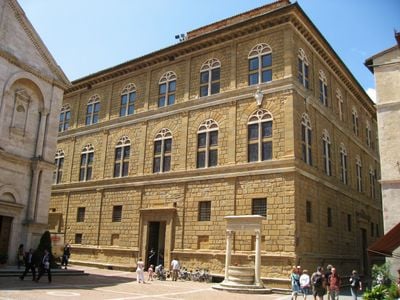
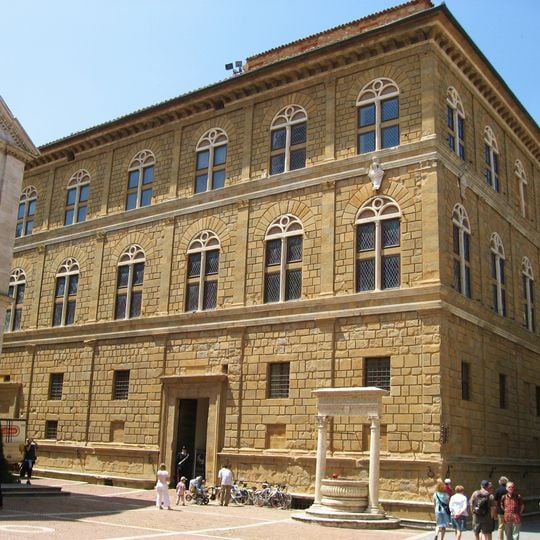
Palazzo Piccolomini is a three-story Renaissance palace in Pienza with symmetrical facades and classical ornaments throughout. The building contains a central courtyard, covered loggias, and multiple rooms open to visitors.
Pope Pius II, born Enea Silvio Piccolomini of Pienza, commissioned the palace from Bernardo Rossellino after 1459 as part of his rebuilding of the town as an ideal city. Rossellino modelled it on the Palazzo Rucellai in Florence by his master Leon Battista Alberti, making it one of the earliest Renaissance palaces. Later it served as a film set for Zeffirelli's Romeo and Juliet and the Medici television series.
The palace is still owned by the Piccolomini family and known as the Palazzo Pontificio, after Pius II. Its stone facades carry the family coats of arms with apostolic insignia in gold and silver, set between the arched windows. The garden keeps its late-15th-century octagonal well, carved with the crescent, keys and tiara of the Piccolomini crest.
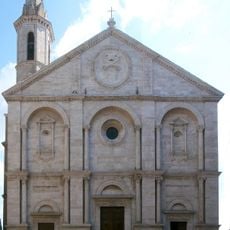
The palace stands in the centre of Pienza beside the Duomo, on the paved square; the garden lies on the south side and is reached through the building. The garden is small and terraced, with gravel paths crossed by box hedges, and its three-arched loggia opens onto the Val d'Orcia. The lower rooms under the garden, once stables, are covered by vaults fed by a drainage system.
The garden on the south side ends in a wall pierced by three arches that frame the Val d'Orcia; the view was part of Rossellino's design, not an accident of the site. In the garden stand a large octagonal well and a fountain carved with fruit garlands, both from the late 15th century. The well bears the crescent, keys and tiara of the Piccolomini coat of arms.
The community of curious travelers
AroundUs brings together thousands of curated places, local tips, and hidden gems, enriched daily by 94,529 contributors worldwide.