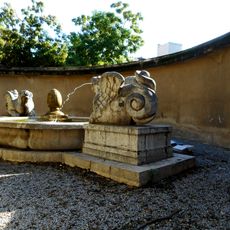
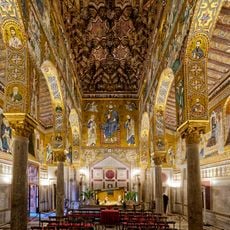
Walls of Palermo, Medieval defense walls in Palermo, Italy
The walls of Palermo are the city's successive defensive circuits. Of the Punic-Roman walls, which divided the Paleapoli from the Neapoli, fragments remain near via Maqueda at piazza Bellini and from via degli Schioppettieri to via dei Candelai. Of the 16th-century bastioned enceinte, the Bastione della Balata along Corso Alberto Amedeo, the Bastione di San Vito behind the Teatro Massimo and the Bastione dello Spasimo near Piazza Magione survive, with a long stretch facing the Foro Umberto I.
The first wall circuit protected the Phoenician settlement and was later expanded and reinforced under Arab and Norman rule. These phases of growth show how the city adapted its defense structures to new political control and changing needs.
The name Cassaro comes from the Arabic al-Kasr, "the fortified", a reminder of the Arab-era walled core. The Arab geographer Ibn Hawqal listed eight of the nine city gates, including Bab al-Bahr, the sea gate, where craftsmen made the wooden clogs called patitelli. Fragments of the Punic-Roman wall can still be seen near Piazza Bellini on Via Maqueda.
Visible stretches are scattered: the Bastione della Balata along Corso Alberto Amedeo, the Bastione di San Vito behind the Teatro Massimo and the Bastione dello Spasimo near Piazza Magione. A long section faces the Foro Umberto I, where its walkable top forms the Passeggiata delle Cattive. Near the port, the restored Castello a Mare is now an archaeological park used for events and concerts.
The defensive system cleverly used two rivers, the Kemonia and the Papireto, as natural moats around the city. These water-based defenses made the city far harder to attack during medieval times and were a key reason the fortification lasted so long.
The community of curious travelers
AroundUs brings together thousands of curated places, local tips, and hidden gems, enriched daily by 94,028 contributors worldwide.