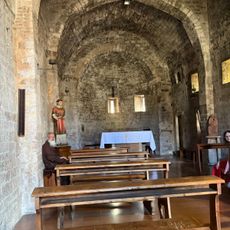
Assisi Diocesan Museum, Religious museum in Assisi, Italy.
The Assisi Diocesan Museum occupies the underground spaces beneath the Cathedral of San Rufino and the Palazzo dei Canonici, with two entrances: one inside the cathedral near the Chapel of the Holy Eucharist and one on Piazza San Rufino. Its nine sections display about 100 of its roughly 300 works, including Roman sarcophagi, 11th-century capitals, and detached frescoes.
The museum was established in 1941 to safeguard artworks from the Cathedral and local prayer chapels run by confraternities. The collection later expanded through acquisitions and donations of religious objects spanning multiple centuries.
The oldest processional banner in the confraternity room dates to 1378 and belonged to the Confraternity of St. Francis of the Stigmata. Frescoes of the Passion, detached from the oratory of San Rufinuccio, are by Puccio Capanna and Pace di Bartolo. A banner painted by Orazio Riminaldi (1593-1630) for the Confraternity of Santa Caterina shows the martyrdom of the saint on one side and Saints James and Anthony Abbot on the other.
You can enter through either the Cathedral doorway or the Piazza San Rufino entrance at street level. Wear comfortable shoes since the path involves stairs and narrow underground passages.
The cloister of the museum, built in the 11th century, has at its centre a Roman-era well known as the Pozzo della Mensa. The cloister is framed by a portico with twin arches and bracket capitals. The well is the only ancient element the sources record in this courtyard.
The community of curious travelers
AroundUs brings together thousands of curated places, local tips, and hidden gems, enriched daily by 93,001 contributors worldwide.