Egyptian Museum of Milan, Egyptological museum in Sforza Castle, Milan, Italy.
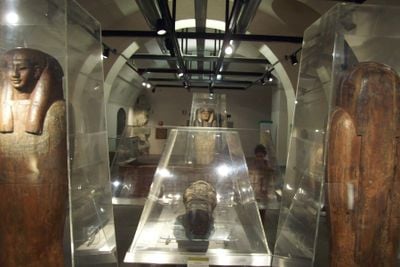
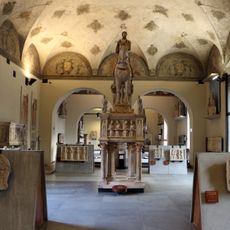
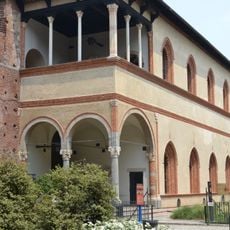
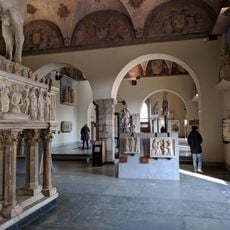
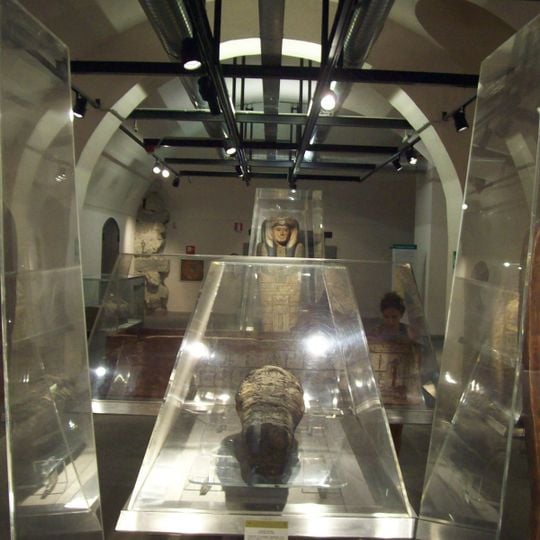
The Egyptian Museum of Milan occupies the underground level of the ducal courtyard in Sforza Castle, in rooms with pale plastered walls, a vaulted ceiling and exposed dark metal pipes. Its seven sections cover writing, pharaohs, deities and cults, daily life, the funerary cult, Achille Vogliano's excavations and mummies, sarcophagi and funerary masks. A small wrapped mummy from Greco-Roman Thebes lies in a clear rectangular case, with carved wooden coffin elements standing in taller cases behind it.
The first ancient Egyptian artefacts reached Milan in the 1820s, and ownership of the collections passed to the Municipality of Milan in 1900. Excavations in Egypt by Achille Vogliano in the 1930s brought the number of exhibited pieces to 3,000. After a nine-year closure, the museum reopened on 5 March 2026.
The seven sections are named for writing, the pharaoh, deities and cults, daily life, the funerary cult, the Vogliano excavations, and mummies, sarcophagi and masks. A cube statue with an enigmatic face greets visitors at the entrance. The funerary cult section holds papyri of the Book of the Dead, while the mummy section displays a Greco-Roman mummy from Thebes.
You enter through the castle, and you should allow enough time to explore the underground spaces and take in what you see. Signs guide you through the rooms, so you can move at your own pace and enjoy the displays.
The mummy in the glass case is a Greco-Roman period mummy from Thebes, shown in the section on mummies, sarcophagi and funerary masks. The Book of the Dead papyri are kept in the funerary cult section, not with the mummy. The entrance is guarded by a cube statue with an enigmatic face.
The community of curious travelers
AroundUs brings together thousands of curated places, local tips, and hidden gems, enriched daily by 93,292 contributors worldwide.