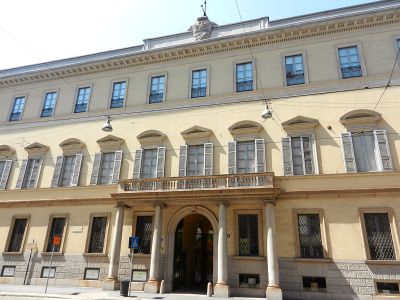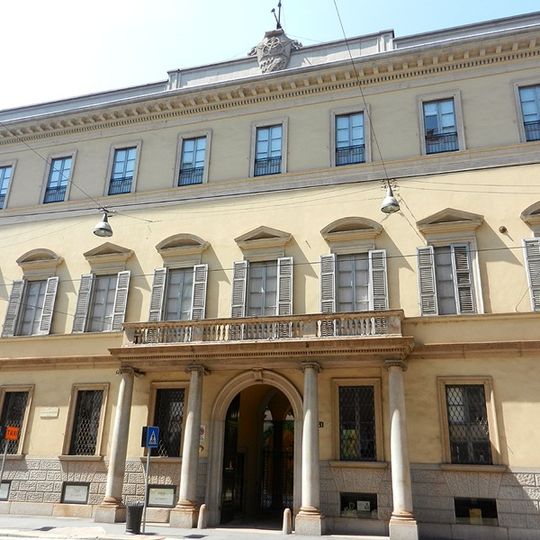
Palazzo Borromeo d'Adda, Neoclassical palazzo in Via Manzoni, Milan, Italy.
Palazzo Borromeo d'Adda is a neoclassical city palazzo on Via Manzoni 39 in Milan, with a long facade marked by regularly spaced windows across several floors. The windows on the main floor alternate between triangular and curved pediments, and three entrance portals punctuate the street front, the central one framed by pink granite columns.
An 18th-century palace already stood on the site before Marquis Febo d'Adda, a noted patron of the arts, had it rebuilt in Neoclassical forms from 1820. He entrusted the project to the architect Girolamo Arganini, who gave the facade its late Neoclassical appearance. The building belonged historically to the sestiere of Porta Nuova.
Stendhal described the palazzo in his chronicles, recalling that he got off his horse amazed and climbed a superb staircase; he wrote that it was the first time architecture had such an effect on him. The building's name pairs the Borromeo and d'Adda families, and it stands at Via Manzoni 39/41, in the former sestiere of Porta Nuova.
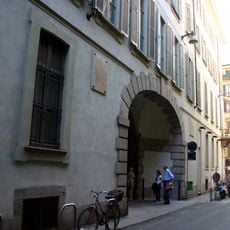
The palazzo is easy to spot along Via Manzoni and is best viewed from the opposite side of the street to take in the full width of the facade. Since it is a private residence, the interior is not open to the public.
Behind the facade, the building contains two separate inner courtyards, which is unusual for a city palazzo of this size in Milan. One of them has been turned into a planted garden that is completely hidden from the street.
The community of curious travelers
AroundUs brings together thousands of curated places, local tips, and hidden gems, enriched daily by 92,937 contributors worldwide.